

5 Best Talking Watches for the Blind: 2026 Professional Review

For individuals living with blindness or low vision, time management is a cornerstone of independence. While smartphones have integrated voice assistants, the tactile reliability of a dedicated talking watch remains unsurpassed for daily convenience. Whether you are a senior citizen managing medication schedules or a student navigating a busy campus, the right timepiece provides more than just the hour—it provides confidence.
In this 2026 update, we draw on clinical insights from the Optometry Skills team to review the top 5 talking watches on the market. We evaluate them not just on volume, but on “Information Gain”—how much they truly assist the user in a world that isn’t always accessible.
Why Every Detail Matters: The Anatomy of an Accessible Watch
Before diving into our top picks, it is essential to understand that “talking” is only one part of the equation. To rank as a truly helpful assistive device, a watch must address three specific barriers:
- Tactile Navigation: Can the user find the “Talk” button by touch alone?
- Voice Clarity vs. Pitch: Higher-pitched digital voices are often the first sound frequencies lost to age-related hearing decline. Deep, natural male voices usually provide better clarity.
- Maintenance Autonomy: If a watch requires a sighted person to reset the time every six months for Daylight Savings, it fails the “independence” test.
1. Best Overall Accuracy: The Atomic English Talking Watch
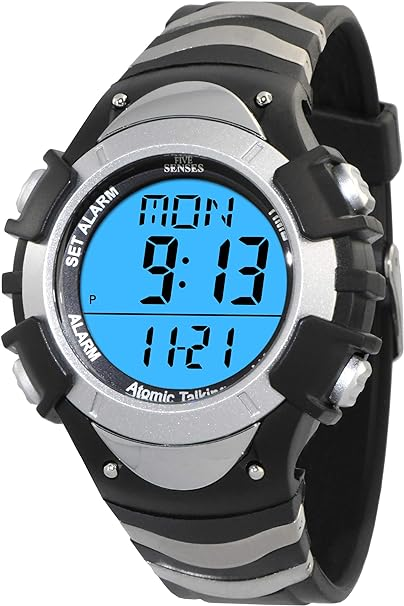
The Atomic English Talking Watch is our top recommendation for users who value precision above all else.
Performance and Syncing
This watch is “Radio-Controlled,” meaning it listens for the low-frequency radio signal broadcast by the National Institute of Standards and Technology (NIST) in Colorado (for US users). It synchronizes daily, ensuring that the time is accurate to within one second every million years.
Key Features:
- Self-Setting Mechanism: Automatically adjusts for Daylight Savings Time (DST).
- Announcement Breadth: Announces time, date, day, month, and year.
- Voice Quality: A clear, resonant male voice with adjustable volume.
✅ The Pros
- Zero-Effort Maintenance: Ideal for users who cannot see small buttons to manually adjust time.
- Dual-Gender Design: Available in styles that fit both men’s and women’s wrists comfortably.
❌ The Cons
- Signal Range: In deep “concrete jungles” or basement apartments, the radio signal can be blocked. Users may need to place the watch near a window overnight to sync.
2. Best for Low Vision: Hearkent Atomic (High Contrast)
Not every “blind” user has total light loss. Many individuals with Macular Degeneration or Glaucoma benefit from high-contrast visuals alongside audio.
The Visual-Audio Hybrid
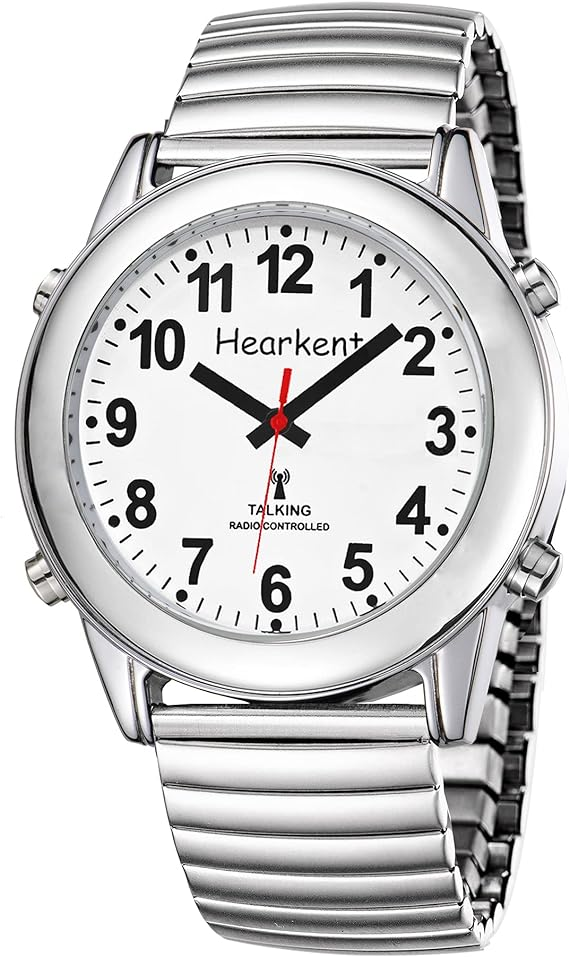
The Hearkent is designed with an “Oversized Jumbo Face.” It features stark black numbers against a matte white background. The hands are thick and distinct, allowing those with remaining peripheral vision to tell the time at a glance without always pressing the audio button.
See price in amazon
✅ The Pros
- Battery Efficiency: The digital-analog hybrid system consumes very little power.
- Tactile Buttons: The buttons are spaced far enough apart to prevent “misfires.”
- Buttons: 4 buttons for each announcement : 2 o’clock button for Time. 4 o’clock button for date. 8 o’clock button tells the reception state and 10 o’clock tells the alarm time or state.
❌ The Cons
- Water Sensitivity: Like most talking watches, the speaker grill is a point of entry for moisture. It is splash-proof but absolutely not shower-proof.
3. Best for Tech-Averse Users: Cirbic Big Talking Watch (One-Button)
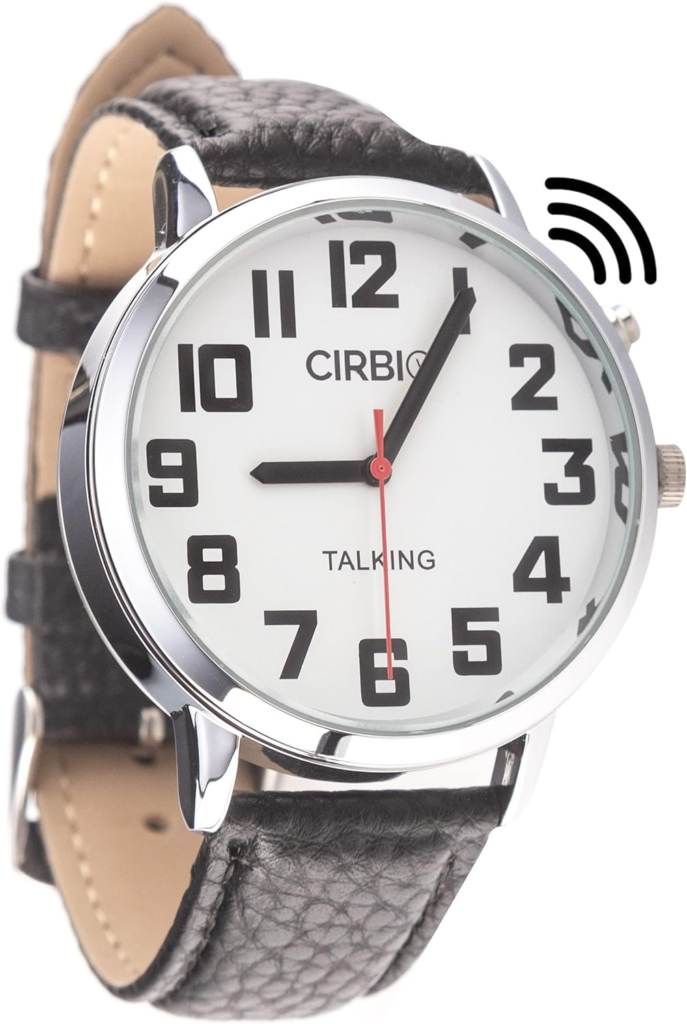
Complexity is the enemy of accessibility. For many seniors, a watch with four or five buttons leads to accidental “Mode” changes that result in the watch staying silent or speaking in a different language.
Simplified Engineering
The Cirbic “Jumbo” model uses a One-Button Protocol. The large button on the front face does one thing: it speaks the time. To hear the date, you simply hold the button for two seconds.
✅ The Pros
- Mistake-Proof: There are no side buttons to accidentally press while moving the wrist.
- Loudness: Features one of the highest decibel ratings in its class.
❌ The Cons
- Manual Setup: Unlike Atomic watches, this requires a sighted assistant for the initial setup. However, once set, it is the easiest watch to use daily.
4. Best for Active Lifestyles: Five Senses Bluetooth (2nd Gen)
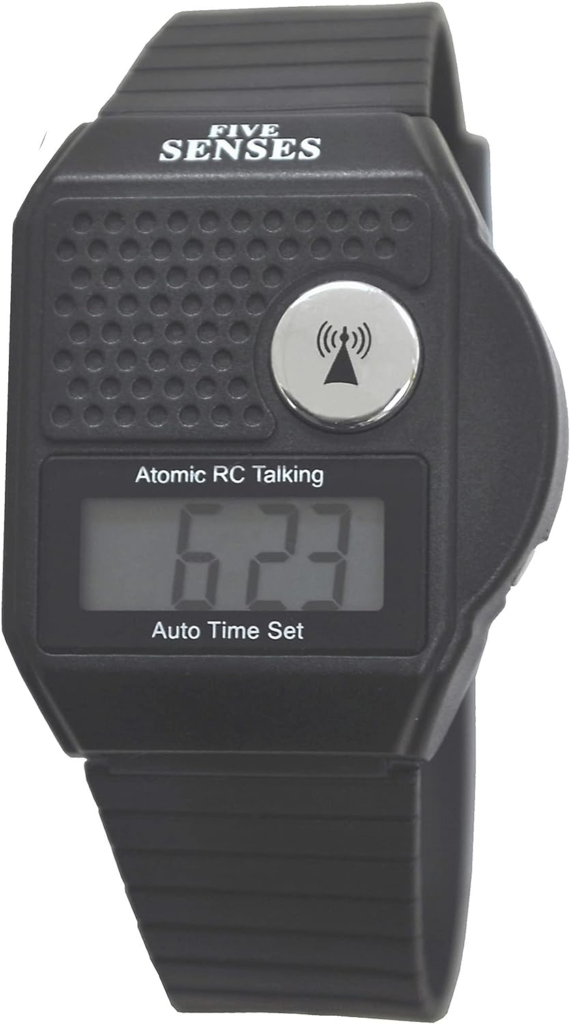
The 2026 iteration of the Five Senses watch bridges the gap between a traditional watch and a smartwatch.
Smartphone Integration
The biggest innovation here is the Bluetooth Sync. By pairing the watch with a smartphone app, the watch automatically pulls the correct time and date from the phone. This eliminates the need for radio signals or manual button mashing.
✅ The Pros
- Smart Reminders: Through the app, you can set specific voice reminders such as “Time to take your heart medication” or “Time to drink water.”
- Elegant Finish: It features a polished metal casing that looks like a high-end fashion watch.
❌ The Cons
- App Dependency: If the user does not own a smartphone or is uncomfortable with apps, this watch loses its primary advantage.
5. Best for Full Independence: The “Vision” Dual-Voice Watch
For users who travel or live in multilingual households, the “Vision” model offers a rare feature: dual-language switching (English/Spanish).
Strategic Versatility
This watch is often favored by clinicians because it includes a “Chime” feature. It can be set to announce the hour automatically, helping those with “Time Agnosia” (difficulty tracking the passage of time) stay grounded throughout the day.
✅ The Pros
- Inexpensive: Often priced 30% lower than Atomic models.
- Strap Options: Comes with an expansion (stretch) band, which is vital for users with arthritis who cannot manage a buckle.
Clinical Buying Guide: How to Choose the Right Model
As an optometry-focused platform, we recommend evaluating a watch based on the user’s specific clinical profile:
Field of Vision
- Central Vision Loss: Prioritize high-volume audio and one-button simplicity, as the user likely cannot see the watch face at all.
- Peripheral Vision Loss: Prioritize high-contrast analog faces (Hearkent style) to utilize the remaining central vision.
Dexterity and Motor Skills
Many people with visual impairments also manage conditions like Parkinson’s or Arthritis.
- Avoid: Small, recessed buttons that require a pen tip to press.
- Choose: Expansion bands and Top-face talk buttons that can be pressed with the palm of the hand.
Maintenance and Longevity Tips
To ensure your talking watch lasts for years, follow these professional maintenance tips:
- The Toothbrush Trick: Use a dry, soft toothbrush to gently clean the speaker grill once a month. Skin cells and lint can clog the grill, muffling the voice.
- Battery Replacement: Most talking watches use CR2025 or CR2032 lithium batteries. Because the “voice” uses more power than the “hands,” the battery may need replacing every 12-18 months.
- Radio Syncing: If your Atomic watch is “off” by a few minutes, it has likely missed its signal. Place it on a window sill facing Colorado (North America) or toward your local transmitter overnight.
Frequently Asked Questions (FAQ)
Q: Can a talking watch be used by someone who is also hard of hearing?
A: Yes, but look for models specifically labeled “Extra Loud.” Alternatively, Tactile (Braille) watches are a better choice for those with dual sensory loss, as they rely on touch rather than sound.
Q: Are there waterproof talking watches?
A: Truly “waterproof” (submersible) talking watches are rare because the speaker requires an opening for sound to escape. Most are labeled “Water Resistant,” meaning they can handle rain but should be removed for swimming or showering.
Q: Do these watches work in different time zones?
A: Most Atomic models allow you to select your time zone (Pacific, Mountain, Central, Eastern). Once selected, the watch will maintain the correct time for that zone automatically.
Conclusion: The Path to Independence
Choosing the best talking watch for the blind is a deeply personal decision. While the Atomic English Talking Watch is our top pick for its hands-off accuracy, the Five Senses Bluetooth model is the future of accessible timekeeping.
At Optometry Skills, we believe that technology should serve the user, not the other way around. By selecting a watch that matches your visual needs and lifestyle, you aren’t just buying a gadget—you’re reclaiming your time.
Looking for more low-vision resources? * Check out our guide on [The 10 Best Magnifiers for Seniors (2026 Edition)]
- Read our clinical breakdown of [Lighting Strategies for Macular Degeneration]

Optometry education for Optometry students and eye care professionals. Managed by qualified optometrists. For informational purposes only — not a substitute for professional eye care.