
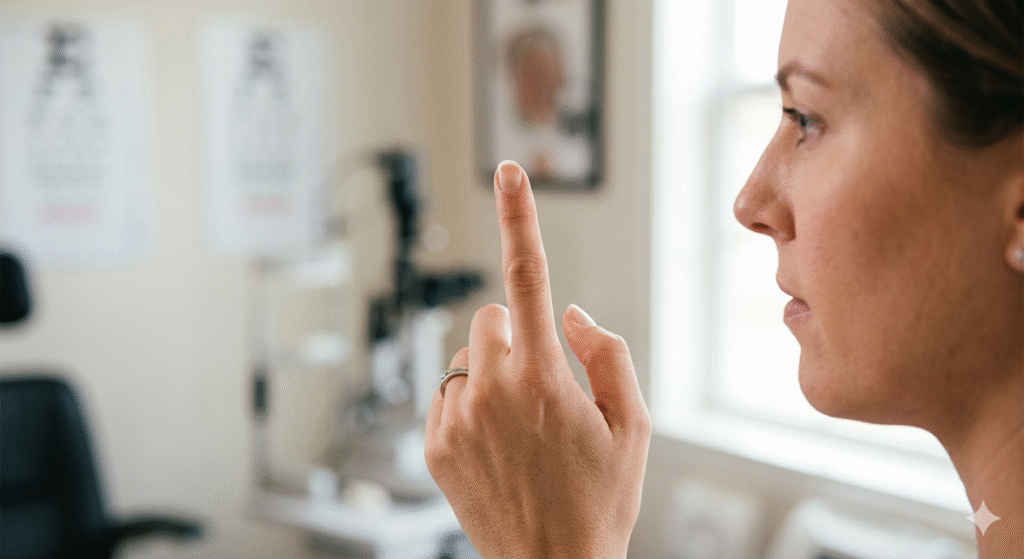
Is it Your Eyes? Easy At-Home Screening for Binocular Vision Dysfunction (BVD)
If you struggle with chronic headaches, dizziness, or a nagging sense of anxiety in crowded aisles at the grocery store, you might have already seen a dozen specialists without finding an answer. Often, the culprit isn’t in your head—it’s in your eyes.
Binocular Vision Dysfunction (BVD) occurs when your eyes are slightly misaligned. Even a tiny misalignment forces your eye muscles to work overtime to correct the image, leading to a cascade of physical symptoms.
The good news? You don’t need a clinical lab to start finding answers. Here are three easy, at-home screening methods to help you determine if BVD is the “missing piece” of your health puzzle.
1. The 5-Minute “Cover Test”
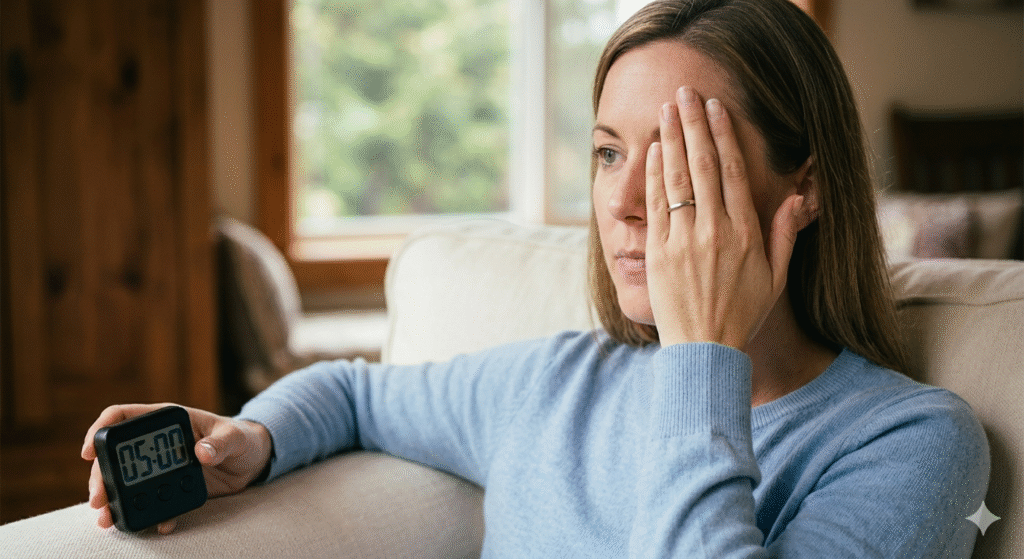
This is perhaps the most telling screening tool. It works on a simple principle: if your symptoms are caused by your two eyes fighting to work together, removing one eye from the equation should provide immediate relief.
- How to do it: 1. Rate your current symptoms (headache, dizziness, or nausea) on a scale of 1 to 10.2. Sit comfortably and cover one eye completely with your hand (or an eye patch) for 5 full minutes.3. During this time, look around the room or out a window. Do not read or look at a phone.
- The Result: If your symptoms significantly decrease or your “head feels lighter” before the timer goes off, it is a strong indicator that your eyes are struggling to coordinate.
2. The Finger Jump Test for BVD
This test checks for physical misalignment that your brain might be trying to hide.
- How to do it:
- Hold your thumb out at arm’s length, right at eye level.
- Focus intently on your thumbnail.
- Slowly alternate closing your left eye and then your right eye.
- The Result: In a healthy system, your thumb may shift slightly side-to-side. However, if your thumb appears to jump up or down, or if the side-to-side jump is dramatically wide, it suggests a vertical or horizontal misalignment characteristic of BVD.
3. The BVD Questionnaire (BVDQ™)
Clinical specialists use a validated survey to identify BVD. You can “self-screen” by checking how many of these common “hidden” symptoms you experience regularly:
| Symptom Category | Red Flags to Watch For |
| Physical Pain | Frequent headaches, migraines, or “sinus” pain; neck and shoulder tension. |
| Balance | Dizziness, lightheadedness, or feeling unsteady while walking. |
| Reading | Words “swimming” on the page, losing your place, or needing a finger to track text. |
| Anxiety | Feeling overwhelmed in large stores (like Costco or Target) or in moving crowds. |
| Driving | Difficulty judging distances or anxiety when cars pass you on the highway. |
Quick Score: If you identify with 3 or more of these categories, the likelihood of a binocular vision issue is significantly higher.
Why Standard Eye Exams Miss BVD
You might be thinking, “But I just had an eye exam and they said I have 20/20 vision!” Standard eye exams focus on visual acuity (how clearly each eye sees individually). BVD is a functional problem—it’s about how the eyes work as a team. Most standard charts don’t test for the tiny micro-misalignments that cause BVD.
Next Steps: Seek a Neuro-Visual Specialist
At-home tests are great for screening, but they aren’t a diagnosis. If these tests hit home, your next step is to find a Neuro-Visual Specialist. Unlike a general optometrist, these experts use specialized equipment to measure micro-deviations and can prescribe Prism Lenses, which do the “aligning” work for your muscles, often providing relief within minutes.
Stop living in a blur. Try the cover test today and see if the relief you’ve been looking for is just one eye-blink away.
Disclaimer: This article is for informational purposes only and does not constitute medical advice. Always consult with a healthcare professional for diagnosis and treatment.
You can use our Online vision therapy tools for other eye excercises and can follow us in Facebook for daily updates

Optometry education for Optometry students and eye care professionals. Managed by qualified optometrists. For informational purposes only — not a substitute for professional eye care.