
The Comprehensive Clinical Guide to Binocular Vision Disorder (BVD): Beyond “20/20” Vision
In the traditional eye exam, the primary metric of success is “20/20” visual acuity—the ability to see small letters on a chart from a distance. However, seeing clearly is only half the battle. Binocular Vision Disorder (BVD) represents a failure in the second half: how the two eyes work together as a team.When the eyes are even slightly misaligned, the brain must exert a massive amount of neurological energy to force them back into alignment to avoid double vision. This constant “tug-of-war” leads to a cascade of physical and psychological symptoms that are frequently misdiagnosed as migraines, vertigo, or even anxiety.
1. What is Binocular Vision Disorder?
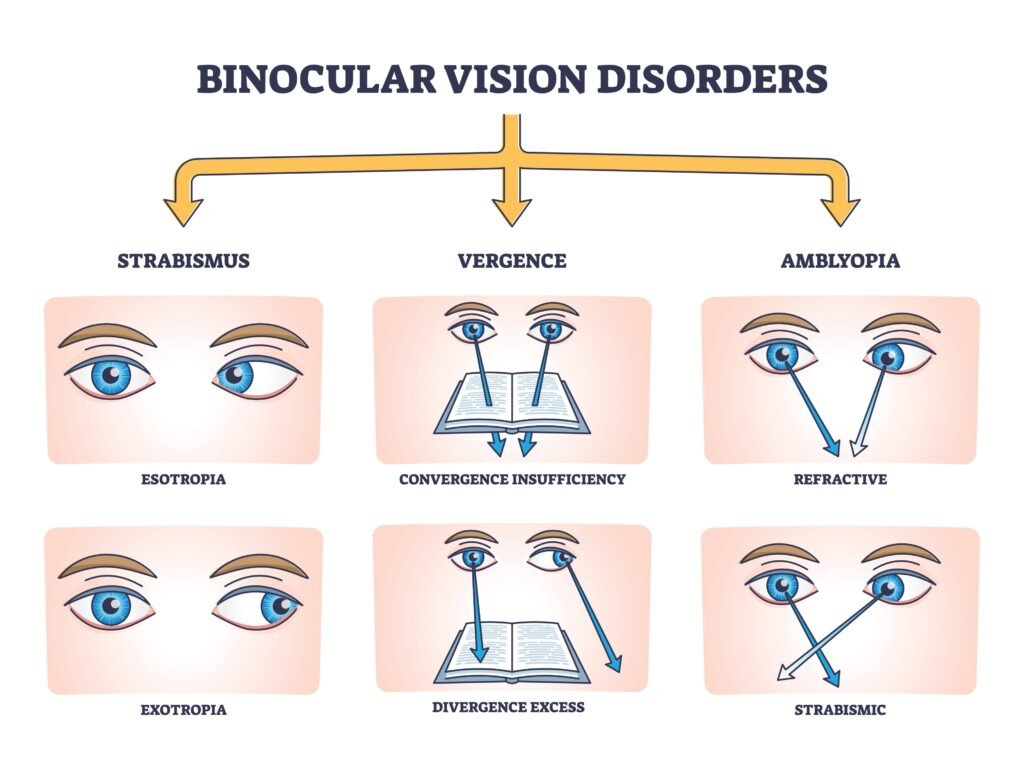
Binocular Vision Disorder is a condition where the two eyes struggle to send a single, synchronized image to the brain. In a healthy visual system, both eyes point at the exact same object, and the brain fuses these two images into one seamless, three-dimensional picture.In patients with BVD, there is a line-of-sight misalignment. This misalignment can be:
Horizontal: One eye wants to turn inward (Esophoria) or outward (Exophoria).Vertical: One eye sits slightly higher than the other (Vertical Heterophoria).
Even a misalignment as small as 0.5 prism diopters—invisible to the naked eye and often missed in standard screenings—can trigger debilitating symptoms.
2. The Mechanics of Misalignment: Why It Hurts
To understand BVD, one must understand the extraocular muscles. Each eye is controlled by six muscles. When a misalignment is present, the brain sends constant corrective signals to these muscles to “pull” the eyes back into place.Over time, these muscles become fatigued and strained. This leads to Trigeminal Dysphoria, where the trigeminal nerve (responsible for sensation in the face and head) becomes overstimulated. This is why BVD is often the “hidden culprit” behind chronic tension headaches and facial pain.
3. Common Symptoms of BVD
The symptoms of BVD are notoriously diverse, leading patients to consult neurologists, ENTs, and primary care doctors before finally seeing a binocular vision specialist.
A. Physical Symptoms
Chronic Headaches: Typically felt in the forehead, temples, or the back of the neck.Dizziness & Vertigo: Feeling “lightheaded” or off-balance, especially when walking in crowded spaces like grocery stores.Nausea: Similar to motion sickness, often triggered by scrolling on a phone or driving.Shoulder & Neck Pain: Caused by the patient unconsciously tilting their head to compensate for a vertical misalignment.
Shadowing or Ghosting: Seeing a faint “ghost” image around letters (often mistaken for astigmatism).Light Sensitivity (Photophobia): Bright lights make the struggle to fuse images harder.Diplopia: Occasional or constant double vision.
Words Swimming: Letters may appear to move, vibrate, or jump on the page.Low Comprehension: Having to re-read lines multiple times because the brain is too focused on the physical act of seeing to process the meaning.
4. Sub-Types of Binocular Vision Disorders
BVD is an umbrella term. To treat it effectively, clinicians must identify the specific dysfunction:
Vertical Heterophoria (VH)
This is one of the most common yet overlooked forms of BVD. One eye views an object slightly higher than the other. The body often compensates by tilting the head toward the shoulder, which can lead to chronic neck pain and “pseudo-scoliosis.”
Convergence Insufficiency (CI)
The eyes have a natural tendency to drift outward when performing near tasks (like reading or using a laptop). This is a leading cause of digital eye strain and is highly prevalent in students and office workers.
Superior Oblique Palsy
A weakness in one of the specific muscles (the superior oblique) that leads to vertical and torsional misalignment.
5. Why Standard Eye Exams Miss BVD
Most routine eye exams focus on refraction (prescription for glasses) and ocular health (glaucoma, cataracts). They use a “cover test” to look for large, obvious deviations.However, BVD often involves latent misalignments. These are hidden because the brain is working overtime to correct them during the short duration of a standard test. It requires specialized testing, such as:
Maddox Rod Testing: To isolate each eye’s position.Associated Phoria Testing: Using polarized lenses to see how the eyes behave when both are open and active.Vergence Facility Testing: Measuring how quickly the eyes can “jump” between different alignment demands.
6. Treatment Options: How to Fix the Teamwork
The good news is that BVD is highly treatable. There are two primary avenues for relief:
A. Micro-Prism Lenses
Prisms are special lenses that bend light before it enters the eye. Instead of forcing the eye muscles to move to find the image, the prism moves the image to where the eye naturally wants to rest.
The Result: Immediate relief. The muscles relax, the “ghosting” disappears, and the headaches subside.
B. Vision Therapy (Neuro-Visual Rehabilitation)
Vision therapy is like “physical therapy for the brain and eyes.” Through a series of programmed exercises (such as Eccentric Circles or Brock Strings), patients can train their brain to control the eye muscles more efficiently. This often provides a long-term cure rather than just a “crutch” like glasses.
7. BVD and the “Anxiety” Connection
A significant number of patients diagnosed with Agoraphobia (fear of open spaces) or Panic Disorder actually have BVD. When a person with BVD enters a high-stimulus environment—like a mall with high ceilings and fluorescent lights—their visual system becomes overwhelmed. The brain receives conflicting signals about where the body is in space, triggering a “fight or flight” response. Treating the eyes often causes the “anxiety” to vanish.
8. Conclusion: The Path to Recovery
If you suffer from chronic headaches, dizziness, or struggle with reading despite having “perfect” vision, you may be suffering from Binocular Vision Disorder.
The first step is seeking a Functional Vision Assessment from an optometrist specializing in binocular vision or vision therapy. You don’t have to live with a visual system that is constantly at war with itself. By aligning the eyes, you align the life.You can use our Online vision therapy tools for other eye excercises and can follow us in Facebook for daily updates

Optometry education for Optometry students and eye care professionals. Managed by qualified optometrists. For informational purposes only — not a substitute for professional eye care.