
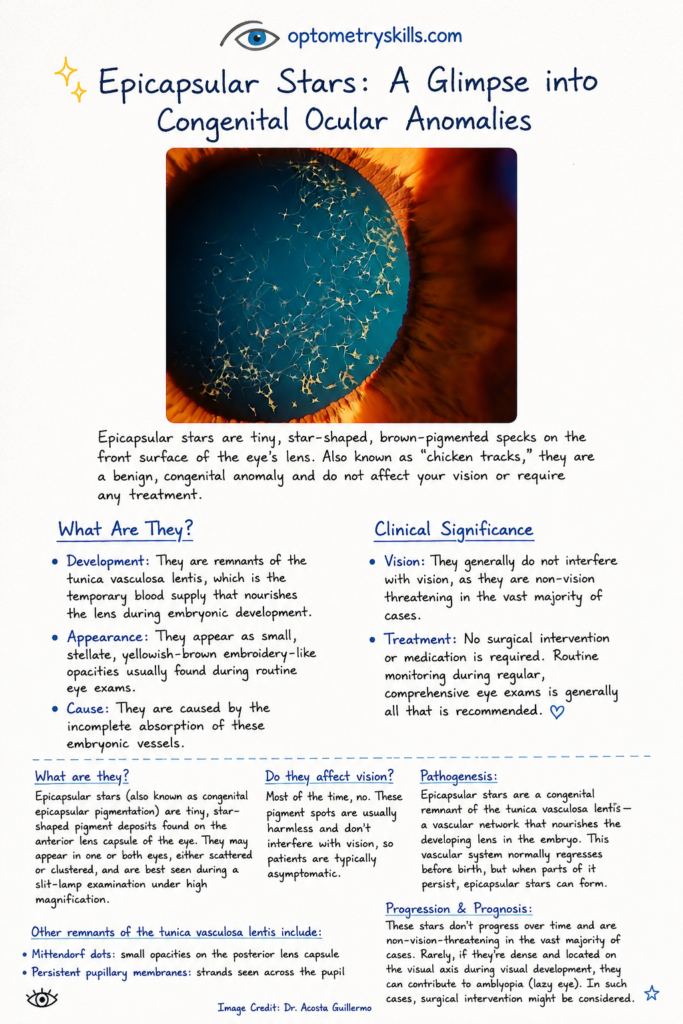
What are Epicapsular stars?
Epicapsular Stars: Tiny Congenital Pigment Deposits on the Lens
During a routine slit-lamp examination, an optometrist may notice delicate, star-shaped brown or golden specks scattered across the anterior surface of the crystalline lens. These striking patterns are known as epicapsular stars, often affectionately referred to as “chicken tracks.”
Although they may appear unusual, epicapsular stars are typically a benign congenital anomaly that does not affect vision and does not require treatment. They serve as a fascinating reminder of the eye’s embryological development.
What Are Epicapsular Stars?
Epicapsular stars, also called congenital epicapsular pigmentation, are small stellate or embroidery-like pigmented deposits located on the anterior lens capsule.
These deposits:
- May occur in one eye (unilateral) or both eyes (bilateral)
- Can appear as isolated specks or clustered patterns
- Are usually yellowish-brown to dark brown in color
- Are best visualized under slit-lamp biomicroscopy with high magnification
Because of their star-like arrangement, they resemble tiny constellations spread across the surface of the lens.
Embryological Origin
Epicapsular stars are remnants of the tunica vasculosa lentis, a temporary vascular network that surrounds and nourishes the developing lens during fetal life.
Normal Development
During embryogenesis:
- The lens lacks its own blood supply.
- The tunica vasculosa lentis provides nutrients.
- This vascular network normally regresses before birth.
- Small remnants may persist as pigmented deposits on the lens capsule.
When incomplete regression occurs, epicapsular stars may form.
Related Embryological Remnants
Other remnants of the tunica vasculosa lentis include:
Mittendorf Dot
A small circular opacity on the posterior lens capsule, typically inferonasal in location.
Persistent Pupillary Membrane
Fine strands of iris tissue extending across the pupil.
These findings, like epicapsular stars, are usually harmless and congenital.
Clinical Appearance
On slit-lamp examination, epicapsular stars appear as:
- Tiny stellate pigment spots
- Yellowish-brown or golden deposits
- Embroidery-like or lace-like patterns
- Located on the anterior lens capsule
They are stationary and do not migrate or increase significantly over time.
Symptoms
Most patients are completely asymptomatic.
Common features include:
- Normal visual acuity
- No glare or halos
- No reduction in contrast sensitivity
- Incidental discovery during routine eye examination
Patients are often unaware of their presence.
Do Epicapsular Stars Affect Vision?
In the vast majority of cases, no.
These deposits are superficial and sparse, so they do not obstruct the visual axis enough to interfere with sight.
Rare Exception
If the deposits are:
- Dense
- Centrally located
- Present during the critical period of visual development in infancy
they may theoretically contribute to deprivation amblyopia, though this is exceedingly uncommon.
Differential Diagnosis
Epicapsular stars should be distinguished from other lens opacities and pigment deposits such as:
- Anterior polar cataract
- Pigment dispersion syndrome
- Pseudoexfoliation material
- Inflammatory pigment deposits
- Traumatic lens changes
Their congenital, stellate appearance and stable course usually make diagnosis straightforward.
Management and Treatment
No Treatment Required
Epicapsular stars are considered a normal developmental variant rather than a disease process.
Management consists of:
- Reassuring the patient or parents
- Documenting the finding
- Routine comprehensive eye examinations
Surgical Intervention
Surgery is almost never indicated and would only be considered in exceptionally rare cases where a dense central opacity significantly affects visual development.
Prognosis
The prognosis is excellent.
Epicapsular stars:
- Remain stable throughout life
- Do not progress
- Rarely affect visual function
- Require no medication or surgery
Patients can be confidently reassured that the condition is harmless.
Key Clinical Pearls
- Also known as chicken tracks
- Congenital remnant of the tunica vasculosa lentis
- Located on the anterior lens capsule
- Appears as brown or golden star-shaped pigment deposits
- Usually discovered incidentally during slit-lamp examination
- Typically asymptomatic
- Does not affect vision in nearly all cases
- No treatment is required

Optometry education for Optometry students and eye care professionals. Managed by qualified optometrists. For informational purposes only — not a substitute for professional eye care.