
Are Polarized Sunglasses Better? The Comprehensive Optometry Guide (2026)
When patients walk into a clinic or browse an online store, one question dominates the eyewear aisle: “Are polarized sunglasses actually better, or is it just a marketing gimmick?” The answer is rooted in physics, not sales. While standard sunglasses protect you from the intensity of light, polarized sunglasses protect you from the geometry of light. For many, they are a transformative upgrade in visual comfort; for others, they are a technical hindrance. This guide breaks down the clinical research, the physical mechanics, and the practical pros and cons of polarized technology.
1. The Physics of Light: Tint vs. Polarization
To understand if polarized lenses are “better,” we must first distinguish them from standard tinted lenses.
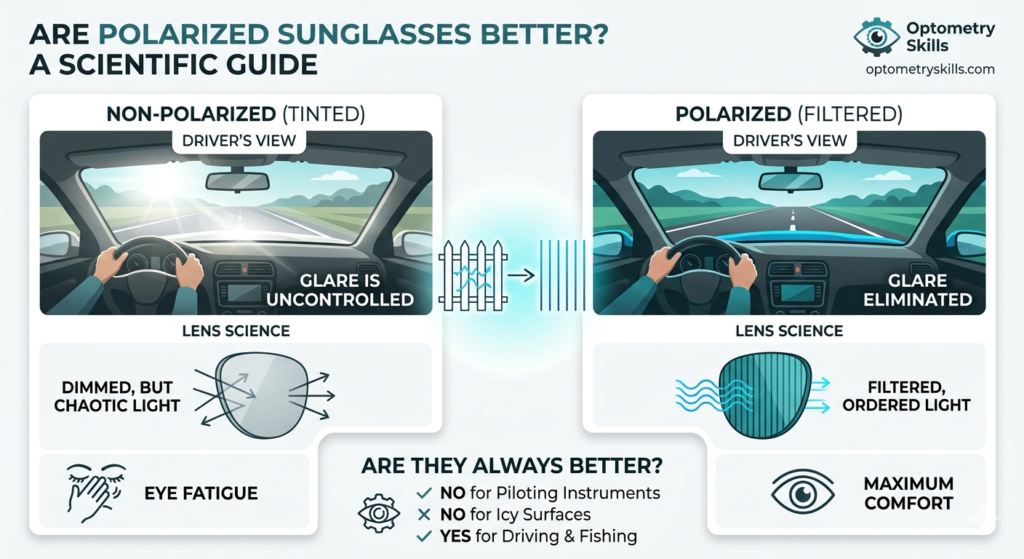
- Standard Tinted Lenses: These act like a dimmer switch. They use dyes or coatings to absorb light evenly across the spectrum. They reduce the total amount of light entering the eye, which helps you stop squinting, but they do nothing to address specific light patterns.
- Polarized Lenses: These act like a chemical “picket fence.” Sunlight is unpolarized—it travels in all directions.However, when light hits a flat horizontal surface (like a lake, a car hood, or a wet road), it reflects and travels in a concentrated horizontal pattern. This is what we call glare.
The Verdict: Polarized lenses are scientifically “better” at managing glare because they contain a vertical filter that effectively “shaves off” the blinding horizontal reflections.
2. The Clinical Benefits: Why Optometrists Recommend Polarization
From a clinical perspective, polarized sunglasses offer several advantages that go beyond just “looking cool.”
A. Reduction of Disability Glare
“Disability glare” occurs when a light source is so bright it physically prevents you from seeing an object. A 2025 study in the Journal of Eye & Vision Science found that drivers wearing polarized lenses recognized road hazards 0.3 to 0.7 seconds faster than those wearing standard tints. At 60 mph, that split second represents nearly 60 feet of stopping distance.
B. Contrast Sensitivity and Color Vibrancy
Because polarized lenses eliminate the “white-out” effect of glare, the underlying colors of the world appear more saturated.
- Water: Anglers use them to see through the surface of the water rather than just seeing a reflection of the sky.
- Landscape: Grass looks greener and skies look a deeper blue because the “haze” of reflected light is removed.
C. Reduced Eye Strain (Asthenopia)
Constant squinting leads to facial muscle fatigue and tension headaches. By providing a uniformly illuminated view, polarized lenses allow the eyes to remain relaxed, which is particularly beneficial for patients with light sensitivity (photophobia) or those recovering from LASIK surgery.
3. When Polarized Sunglasses are NOT Better
As an optometry professional, it is vital to acknowledge the “blind spots” of this technology. Polarization is not a universal “win.”
A. The “Digital Blackout” Problem
Most digital screens (LCD and LED) use polarizing filters to control light. When you look at a smartphone, GPS, or digital dashboard through polarized sunglasses, the two filters can “cross,” making the screen appear black or distorted.
- The Professional Risk: This is why pilots and heavy machinery operators are often advised against polarized lenses; they must be able to read critical instrument panels at a glance.
B. The “Ice Patch” Hazard (Skiing and Cycling)
In sports like downhill skiing or high-speed cycling, glare is actually a visual cue.
- A “glaring” patch on the snow usually indicates black ice.
- A polarized lens might filter that reflection out, making the ice look like soft snow, which can lead to dangerous falls.
C. Night Driving
A common myth is that polarized glasses help with night driving. This is false. Polarized lenses are inherently darker (usually Cat 3 lenses). Wearing them at night further reduces the amount of light reaching the retina, significantly decreasing safety.
4. The “UV Protection” Misconception
One of the most dangerous myths in eye care is that “Polarized = UV Protection.”
| Feature | Polarized Coating | UV400 Coating |
| Purpose | Blocks Glare | Blocks Radiation (UVA/UVB) |
| Mechanism | Chemical filter (Horizontal) | Absorptive material |
| Eye Health | Improves Comfort | Prevents Cataracts & Cancer |
Crucial Advice: You can have a polarized lens with zero UV protection, and a clear lens with 100% UV protection. Always look for the UV400 label regardless of polarization.
5. Comparison Table: At a Glance
| Activity | Are Polarized Better? | Reason |
| Driving (Day) | Yes | Reduces road and dashboard glare. |
| Fishing / Boating | Essential | Allows you to see beneath the water’s surface. |
| Golfing | Maybe | Helps find the ball, but can affect depth perception on the green. |
| Skiing | No | Can hide icy patches. |
| Aviation | No | Interferes with LCD cockpit displays. |
| General Hiking | Yes | Increases contrast and color vibrancy. |
6. How to Choose: A Patient’s Checklist
If you’re deciding whether to spend the extra $30–$100 on the polarization upgrade, ask yourself these three questions:
- Do I spend more than 2 hours a day near water or driving? If yes, buy polarized.
- Does my car use a “Heads-Up Display” (HUD) on the windshield? If yes, stick to standard tints, as polarization will make the HUD disappear.
- Am I sensitive to light? If yes, the glare reduction of polarization will offer significantly more relief than standard tints.
7. Conclusion: The Optometry Skills Perspective
Are polarized sunglasses better? For the majority of daytime outdoor activities, the answer is a resounding yes. They provide a level of visual clarity and safety that a simple dark tint cannot match. However, “better” is a subjective term that depends on your environment.
For the professional driver or the weekend fisherman, they are a necessity. For the pilot or the competitive skier, they may be a liability. As with all things in optometry, the “best” lens is the one tailored to your specific lifestyle.
Sources & References
- PMC (PubMed Central): Examining polarizing and non-polarizing filters for road sports (2025).
- Cleveland Clinic: Polarized vs. Non-Polarized Sunglasses: Which are better for your eyes? (2026).
- All About Vision: The science of glare and visual performance in driving.
- Journal of Clinical Optometry: Post-surgical light sensitivity and the role of polarized filters.
- American Academy of Ophthalmology: Guidelines for UV and Glare Protection.
SEO Meta Data for this Article:
- Title: Are Polarized Sunglasses Better? Pros, Cons, and Clinical Facts
- Description: Is the polarized upgrade worth it? We analyze the science of glare, UV protection, and why pilots should avoid them. Read the expert guide at OptometrySkills.com.
- Keywords: Are polarized sunglasses better, polarized vs non-polarized, benefits of polarized lenses, eye strain, driving sunglasses.
Optometry education for Optometry students and eye care professionals. Managed by qualified optometrists. For informational purposes only — not a substitute for professional eye care.