
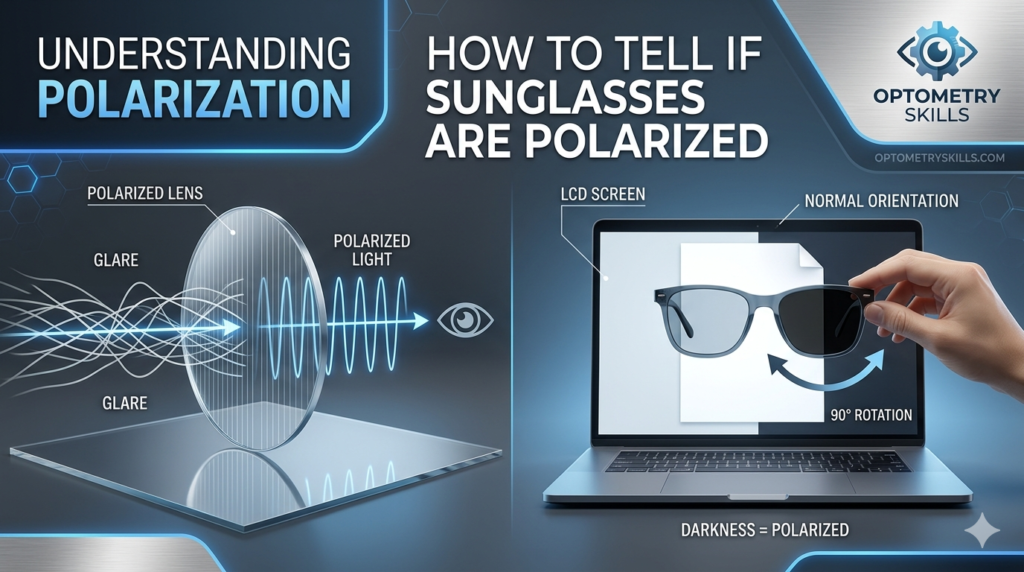
How to Tell if Sunglasses are Polarized
In the world of eyewear, “polarized” is often used as a synonym for “high quality,” but the term represents a specific scientific phenomenon rather than a general mark of excellence. For outdoor enthusiasts, drivers, and athletes, understanding whether your lenses are polarized is not just a matter of curiosity—it is a matter of safety and visual performance.
Polarized lenses were a revolutionary advancement in optical technology, first made commercially viable by Edwin H. Land in 1936. By utilizing a synthetic material he called “Polaroid,” Land found a way to filter light to eliminate the blinding glare that reflects off horizontal surfaces like water and asphalt. Today, these lenses are essential tools for anyone from professional anglers to daily commuters.
However, many “dark” sunglasses on the market are merely tinted and offer no polarization benefits. This guide provides a deep dive into the mechanics of polarization and five definitive, research-backed methods to test your sunglasses at home or in the store.
1. The Computer Screen Test (LCD/LED)
This is perhaps the most reliable and scientifically sound “DIY” test available. Most modern digital displays—including laptops, tablets, and smartphones—use a polarizing filter to reduce glare and control the light emitted by the screen.
The Procedure
- Turn on your device: Open a blank white document or a bright image to maximize light output.
- Hold your sunglasses: Place the lenses between your eyes and the screen.
- The Rotation: Slowly rotate the sunglasses to a 90-degree angle (vertical).
- The Result: If the lenses are polarized, the screen will appear to turn black or significantly darker. If the lenses are non-polarized, the screen’s brightness will remain consistent regardless of the angle.
Why It Works
Digital screens emit light that is already polarized in a specific direction (usually diagonally or horizontally). When you rotate your polarized sunglasses to 90 degrees, you are essentially “crossing” the filters. This blocks nearly all light from passing through, a phenomenon known in physics as Malus’s Law.
2. The Reflective Surface Test
Because polarized lenses are designed specifically to eliminate “horizontal glare,” you can test them by looking at surfaces where this glare naturally occurs.
The Procedure
- Find a “Glaring” Spot: Look for a reflective surface under bright light—a car’s hood, a puddle, or a glass tabletop.
- Observe the Glare: Note the bright, white-light reflection hitting your eyes.
- Tilt Your Head: Put the sunglasses on and slowly tilt your head toward your shoulder (90 degrees).
- The Result: If the glare intensifies as you tilt your head and disappears when your head is upright, the lenses are polarized. If the glare remains constant at all angles, they are standard tinted lenses.+1
The Science of Glare
When sunlight hits a flat surface (like a road), the light waves reflect and travel horizontally. This concentrated horizontal light is what we perceive as glare. Polarized lenses are manufactured with a vertical chemical filter. Much like a picket fence only allows vertical objects through, these lenses only allow vertical light waves to pass, effectively “shaving off” the horizontal glare.+2
3. The Double-Lens Comparison
If you already own a pair of sunglasses that you know are polarized (or if you are in a store with multiple pairs), you can use them as a “control” to test an unknown pair.
The Procedure
- Alignment: Hold both pairs of sunglasses in front of you, one behind the other.
- The Pivot: Keep the “known” pair stationary and rotate the “unknown” pair 90 degrees.
- The Result: If the overlapping section where the two lenses meet turns pitch black, both pairs are polarized. If the overlapping area remains transparent (just double-tinted), the unknown pair is not polarized.+1
4. The “Rainbow” Effect on Windows
Polarized lenses can reveal “stress patterns” in tempered glass that are invisible to the naked eye. This is common in side and rear car windows.
The Procedure
- Look at a Car Window: While wearing the sunglasses, look at the side or back window of a vehicle (front windshields are often laminated differently and may not show this).
- The Result: If you see a faint checkerboard pattern or “rainbow” spots, your lenses are polarized. These patterns are the result of the tempering process used to make the glass shatter-proof; polarized lenses make these internal stresses visible.
5. Identifying the “P” Mark
While physical tests are best, many manufacturers include a subtle “P” or “Polarized” etching on the lens or the interior of the temple arm.
- Premium Brands: Look for a small “P” near the brand logo on the corner of the lens.
- Verification: Note that a sticker is not proof. Always verify a sticker’s claim with the Screen Test or Reflective Surface Test, as some low-quality knockoffs use “Polarized” stickers on non-polarized lenses.
Polarized vs. Non-Polarized: A Comparison
| Feature | Polarized Sunglasses | Non-Polarized (Tinted) |
|---|---|---|
| Glare Reduction | Eliminates horizontal reflections | Only dims overall brightness |
| Color Clarity | Enhances contrast and saturation | Can make colors appear “muddy” |
| Best For | Driving, fishing, skiing, beach | Reading digital screens, night driving |
| Visual Comfort | Reduces eye strain from squinting | Basic protection from UV rays |
When Not to Use Polarized Lenses
Despite their benefits, polarized lenses are not always the best choice. Research from the American Academy of Ophthalmology notes that pilots and heavy machinery operators should avoid them because they can make it impossible to read LCD instrument panels or see ice on a runway. Similarly, downhill skiers often prefer non-polarized lenses to help them distinguish the “glare” of dangerous ice patches from soft snow.
The Health Impact: Is It Worth It?
Standard tinted sunglasses protect your eyes from the intensity of light, but polarized lenses protect your eyes from the fatigue of light. Studies have shown that prolonged exposure to glare leads to:
- Accommodative Stress: The eyes constantly trying to focus through a “white-out” of glare.
- Increased Reaction Time: In driving scenarios, glare can delay a driver’s ability to see an object by several seconds.
- Corneal Sunburn (Photokeratitis): While polarization itself doesn’t block UV rays (that is a separate coating), most polarized lenses include UV400 protection, which blocks 99-100% of UVA and UVB radiation.
A Note on UV Protection
A common misconception is that “polarized” means “UV protected.” These are two different technologies. Always ensure your polarized sunglasses are also labeled UV400 to prevent long-term damage like cataracts or macular degeneration.
Summary Checklist
If you are testing your sunglasses right now, follow this quick flow:
- Look at your phone screen.
- Rotate the glasses 90 degrees.
- Does it go black? If yes, you are protected from glare.
By using these methods, you can ensure that your investment in eye health is genuine. Whether you are navigating a wet highway or trying to spot a fish beneath the surface of a lake, the right lenses make the world not just darker, but clearer.
Here are some real-world visual examples to help illustrate the concepts and tests mentioned in the article:
1. The Computer Screen Test
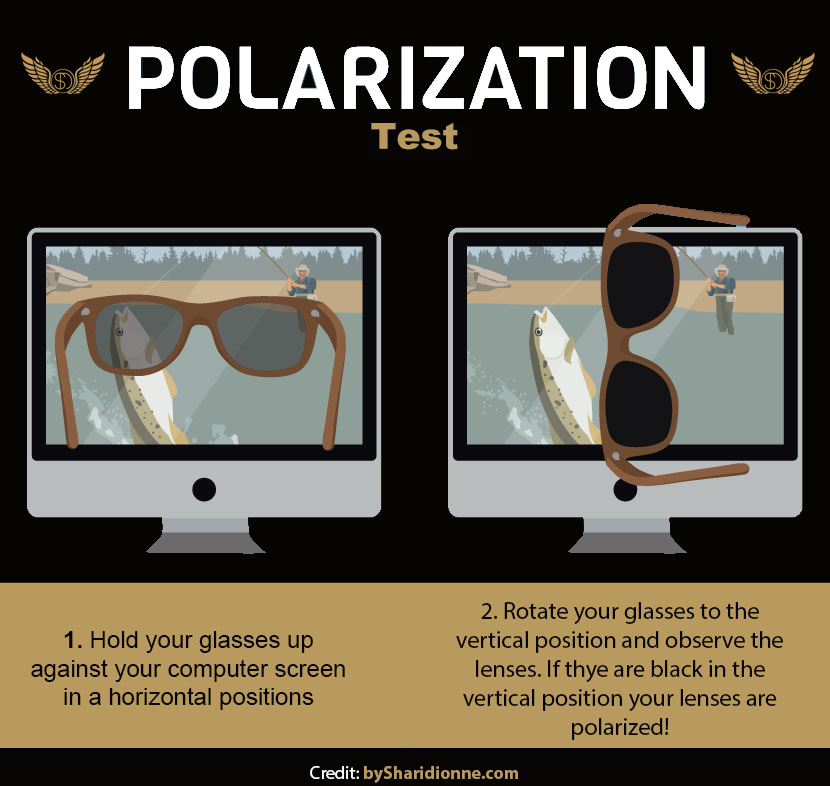
When you rotate polarized lenses in front of an LCD screen, the filter blocks the light, causing the lens to appear black.
Polarization Test Cards
Many optical shops use these specialized cards. The “hidden” image (like a fish or a car) is only visible when viewed through a polarized lens.
Sources & Research Data
- American Academy of Ophthalmology (AAO): What Are Polarized Lenses For? (2024).
- Optica (The Optical Society): Biography of Edwin H. Land and the Invention of Polaroid (2025).
- Journal of Eye & Vision Science: Impact of Polarized Lenses on Driving Safety and Visual Reaction Times.
- Polaroid Corporation Archives: The Development of Synthetic Polarizing Filters.
- iSight Optometry Research: Field Testing Polarization for Consumer Eyewear.
Optometry education for Optometry students and eye care professionals. Managed by qualified optometrists. For informational purposes only — not a substitute for professional eye care.