
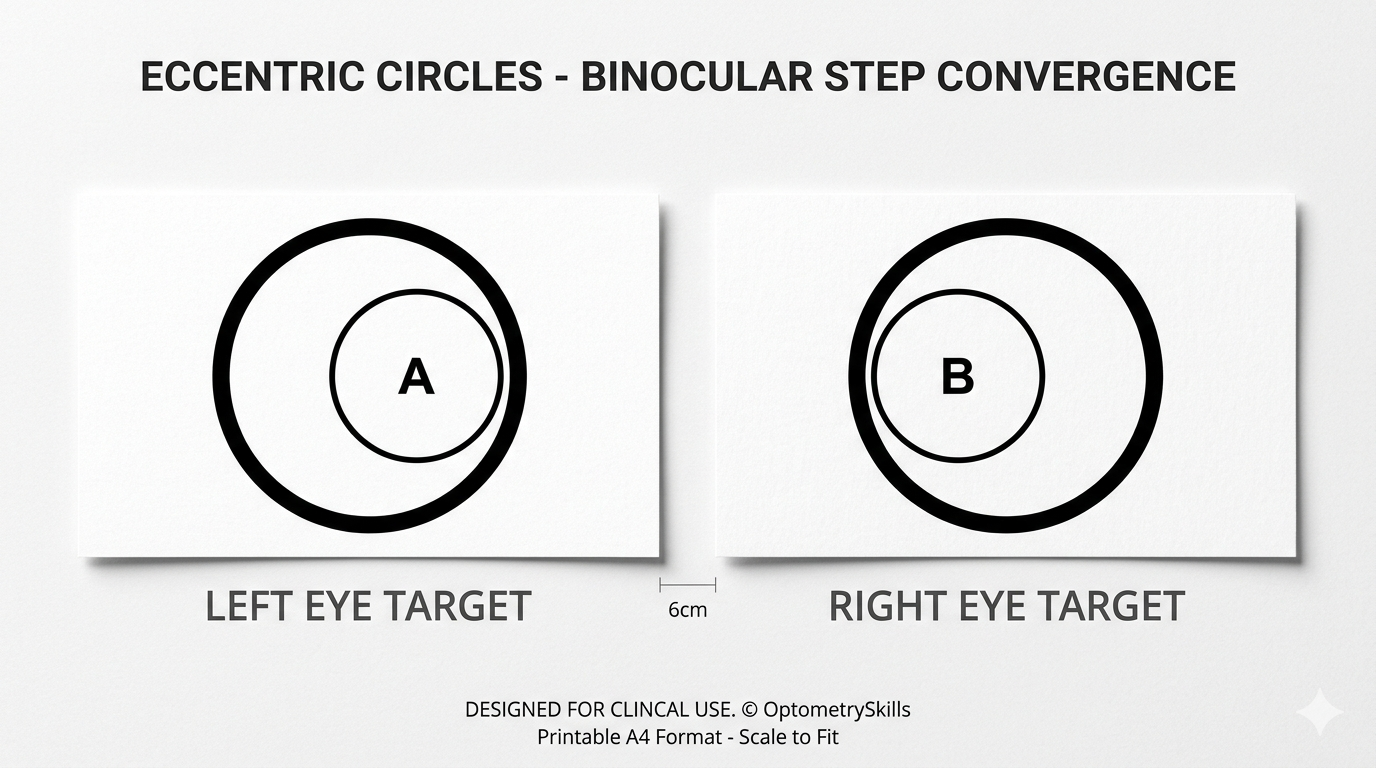
Binocular Step Convergence with eccentric circles vision therapy
Left Eye Target
Right Eye Target
In clinical optometry, the ability to maintain comfortable, single vision isn’t just about strength; it’s about flexibility. Binocular Step Convergence is the high-level visual skill of “jumping” your eyes to a specific near point and locking in focus instantly.
One of the most powerful tools to train this is the Eccentric Circles technique. Whether you are treating Convergence Insufficiency (CI) or looking to optimize your visual performance, this guide breaks down the clinical protocol for mastering step convergence.
What is Binocular Step Convergence?
While “smooth” convergence involves tracking an object as it moves toward the nose (like the Push-Up method), Step Convergence (also known as “jump vergence”) requires the brain to switch instantly between two different vergence demands.
Why It Matters
- Reading Endurance: Frequent “steps” occur when moving your eyes from the end of one line to the start of the next.
- Classroom/Office Performance: Shifting focus from a distant whiteboard or monitor to a near notebook or phone.
- Sports Vision: Rapidly tracking objects moving through different spatial planes.
The Role of Eccentric Circles
Eccentric Circles are dual-ring targets designed to create binocular disparity. When used correctly, they force the brain to fuse two separate images into a single, three-dimensional “float.”
Clinical Design Features:
- Outer Ring: Provides a peripheral fusion lock, stabilizing the binocular system.
- Inner Ring: Targets central fusion and stereopsis (depth perception).
- Suppression Marks: Small letters (“A” and “B”) ensure that both eyes are contributing to the image simultaneously.
Clinical Protocol: The Step Convergence Technique
For successful Step Convergence training, we use the Crossed-Fusion (Base-Out) approach.
1. Initial Setup
Hold your Eccentric Circle cards at a distance of 40cm. Ensure they are level with your eyes and separated by approximately 6cm (or your interpupillary distance).
2. Achieving Fusion (The “Float”)
Look at a point between your face and the cards (using a pointer or your finger). As you cross your eyes, the two cards will split into four. Adjust your convergence until the two middle circles overlap.
- The Result: You should see three circles. The middle one will look smaller and appear to “float” closer to you.
3. The “Step” or “Jump”
Once you have achieved a stable 3D image:
- Look Away: Shift your gaze to a distant object (at least 3 meters away) for 2–3 seconds.
- Snap Back: Look back at the cards and attempt to regain the 3D fused image instantly.
- Goal: You should be able to “snap” into fusion in less than 1 second.
Troubleshooting Suppression & SILO
| Symptom | Clinical Meaning | Solution |
|---|---|---|
| Only 2 circles visible | No convergence occurring. | Use a pointer closer to your nose to guide your eyes in. |
| Letter “A” or “B” missing | Suppression: The brain is ignoring one eye. | Blink rapidly or wiggle the card to “wake up” the suppressed eye. |
| Middle circle is blurry | Accommodative Lag: The eyes are converged but not focused. | Try to “relax” your focus as if looking through the cards while staying crossed. |
| Image looks smaller/closer | SILO Effect: (Small In, Large Out). | This is normal! It confirms your brain is processing the Base-Out demand correctly. |
Export to Sheets
Advancing Your Training
To increase the difficulty and further improve your Vergence Facility:
- Increase Card Separation: Moving the cards further apart increases the convergence demand.
- Add Head Movement: Maintain fusion while gently rotating or tilting your head.
- The “Walk-Back”: Achieve fusion at 40cm, then slowly walk backward while maintaining the 3D float.
Conclusion
The Eccentric Circles – Binocular Step Convergence exercise is a cornerstone of vision therapy. By training the eyes to “step” rather than just “glide,” you build a more robust, flexible, and comfortable visual system capable of handling the high demands of the modern digital world.
Practice vision therapy . Daily Practice can help improve eyes.
You can use our Online vision therapy tools for other eye excercises and can follow us in Facebook for daily updates

Optometry education for Optometry students and eye care professionals. Managed by qualified optometrists. For informational purposes only — not a substitute for professional eye care.