
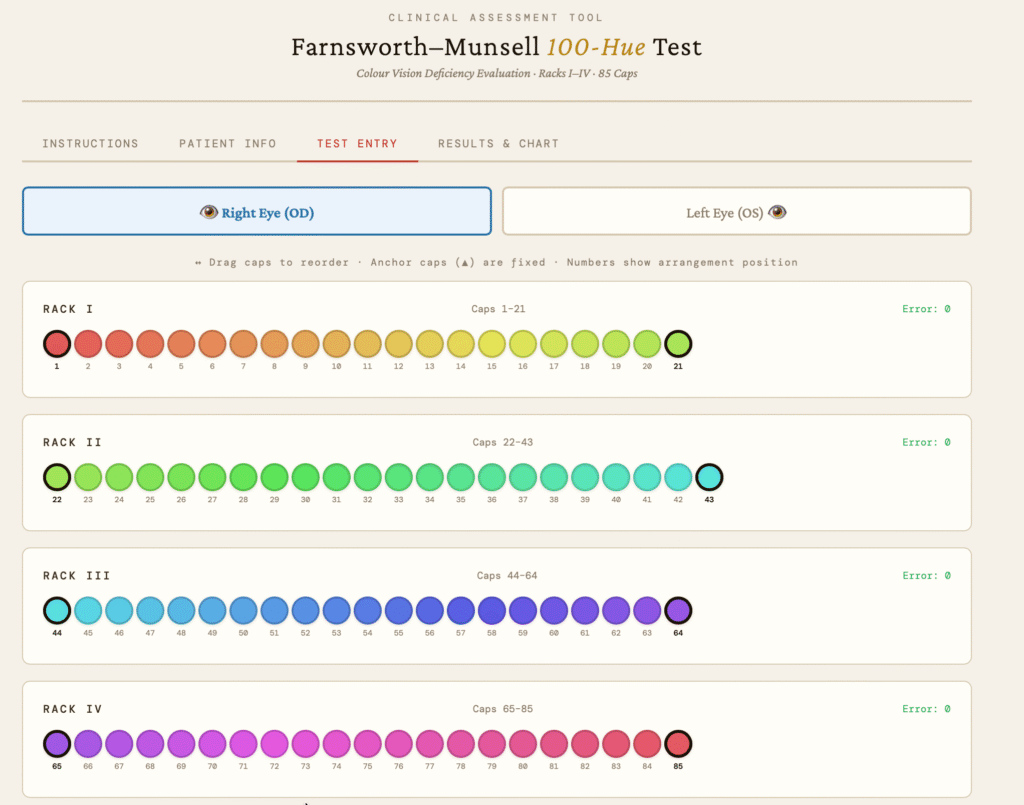
Farnsworth–Munsell 100 Hue Test Online
In clinical optometry, there are moments when standard color vision tests are simply not enough. A patient may pass basic screening, yet still struggle with subtle color differences that affect daily function or professional performance. This is where the Farnsworth–Munsell 100 Hue Test becomes invaluable.
Now, this gold-standard assessment has been transformed into a fully interactive digital tool, designed specifically for optometrists who want both precision and accessibility in their practice.
What is the Farnsworth–Munsell 100 Hue Test?
The Farnsworth–Munsell 100 Hue Test is an advanced color vision test that evaluates a patient’s ability to distinguish fine gradations of hue.
Unlike screening tools that only detect obvious deficiencies, this test:
- Measures subtle color discrimination ability
- Identifies mild and acquired color vision defects
- Provides a detailed error score for clinical interpretation
It is widely used in clinical and occupational settings where accurate color perception is critical.
Introducing the Interactive Version
This digital version has been carefully developed to bring clinical-level testing into a modern, user-friendly interface.
Key Features
- Interactive drag-and-arrange color sequencing
- Smooth, responsive design suitable for clinic use
- Immediate scoring and visual feedback
- No physical caps or trays required
- Accessible across devices
This allows optometrists to perform advanced color vision testing without setup limitations, saving both time and effort.
The test is based on a simple but highly sensitive principle:
- Each set contains a sequence of colored tiles
- The first and last tiles are fixed reference points
- The patient arranges the remaining tiles in correct hue order
Even minor deviations are recorded, producing an error score that reflects the patient’s color discrimination ability.
Clinical Value for Optometrists
This interactive tool is not just convenient—it is clinically meaningful.
1. Detect Subtle Deficiencies
Ideal for identifying early or mild color vision issues that may not appear in screening tests.
2. Monitor Acquired Conditions
Useful in patients with:
- Optic nerve disorders
- Macular disease
- Drug toxicity affecting vision
3. Occupational Screening
Essential for professions requiring high color accuracy, such as:
- Pilots
- Designers
- Technicians
4. Patient Education
The visual nature of the test helps patients understand their condition more clearly.
Advantages Over Traditional Testing
Traditional FM100 testing requires:
- Physical color caps
- Controlled lighting
- Time-consuming setup and scoring
This interactive tool eliminates those barriers:
- No equipment handling
- Faster administration
- Instant results
- Easy repeat testing for follow-up
It seamlessly integrates into modern clinical workflows.
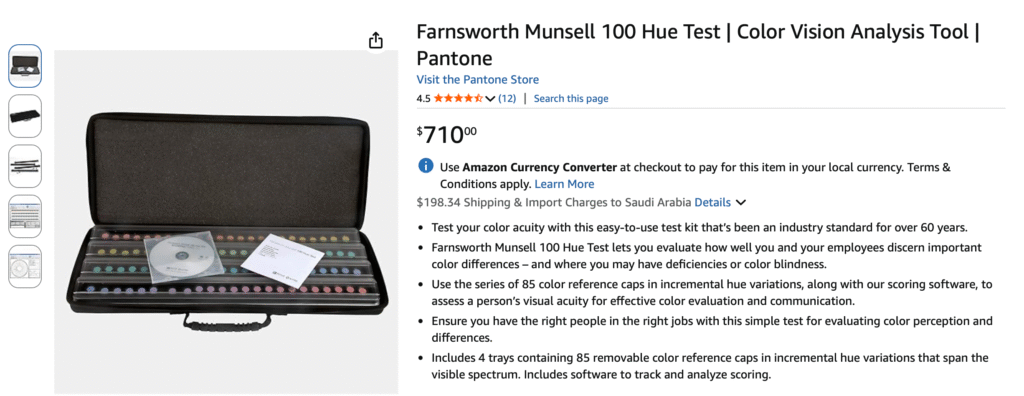
The price of Farnsworth Munsell 100 Hue test for clinic- $710 (amazon link) which we are offering for FREE along with pdf report and result analysis.
Designed for Real Practice Use
This Farnsworth–Munsell 100 Hue Test Online tool is built with clinical intent.
- Structured to reflect real FM100 testing logic
- Designed for optometrists, not just general users
- Suitable for both screening and detailed assessment
Whether you run a busy clinic or provide specialized care, this tool adds practical value to your diagnostic process.
When Should You Use This Test?
Consider using this interactive FM100 Hue Test when:
- A patient reports difficulty distinguishing similar colors
- You suspect acquired color vision loss
- Baseline color vision documentation is needed
- Monitoring progression of ocular conditions
- Evaluating visual performance for specific careers
Integrate It Into Your Practice
With increasing reliance on digital tools, optometry is evolving toward efficiency without compromising accuracy.
This interactive Farnsworth–Munsell 100 Hue Test allows you to:
- Enhance your clinical assessments
- Improve patient engagement
- Save time while maintaining precision
Overview About This Test
The Farnsworth–Munsell 100-Hue Test (FM100) is a sensitive assessment of colour discrimination ability and colour deficiency classification. Despite its name, it uses 85 movable caps across four racks, arranged to represent a complete hue circle. Each of the three forms of dichromatism (protan, deutan, tritan) produces a characteristic failure axis on the polar plot.
Used for: Congenital and acquired colour deficiency · Optic nerve disease monitoring · Macular disease assessment · Occupational colour aptitude testing
SetupPre-Test Conditions
- Test under standard illuminant D65 daylight (6500 K), ideally a colour-matching booth. Avoid incandescent or fluorescent sources.
- Corrected vision must be adequate — the test is primarily chromatic, not acuity-dependent. Ensure spectacles/contacts are worn.
- Allow 2–3 minutes light adaptation before commencing.
- Present one rack at a time with the lid closed on remaining racks to prevent memorisation.
- The two anchor caps at each rack end are fixed and labelled — do NOT move them. Only the intermediate caps are rearranged by the patient.
ProcedureHow to Administer
- Remove the intermediate caps from Rack I and scramble them in front of the patient.
- Ask the patient: “Please arrange these coloured caps in order, so that the colours form a smooth gradual sequence between the two end caps.”
- Time each rack — normal completion is 2–4 minutes per rack; excessive time may indicate colour confusion.
- Repeat for Racks II, III, and IV.
- Record the cap sequence exactly as placed. Enter the position numbers into this tool.
- Test each eye separately (right eye first by convention).
⚠ Remind the patient: “There is no right or wrong — just arrange what looks most natural to you.” Avoid prompting or correction during the task.
ScoringError Score Calculation
For each cap, the error score is: |Positionleft − Correct| + |Positionright − Correct|. Scores range from 0 (perfect) to 4 (maximum error). Total Error Score (TES) is the sum of all individual scores.
- TES < 16: Superior colour discrimination
- TES 16–100: Normal range (age-dependent)
- TES > 100: Colour deficiency likely
- TES > 200: Severe deficiency or acquired pathology
The polar plot reveals the axis of confusion: protan = red-purple axis (~0°/180°); deutan = red-green axis; tritan = blue-yellow axis (~90°/270°).
Final Thoughts
Color vision is more than identifying red and green—it is about perceiving the world in its true detail.
By bringing this advanced test into an interactive format, you now have the ability to assess that precision anytime, anywhere, without the limitations of traditional methods.
Follow us in Facebook for more updates

Optometry education for Optometry students and eye care professionals. Managed by qualified optometrists. For informational purposes only — not a substitute for professional eye care.