
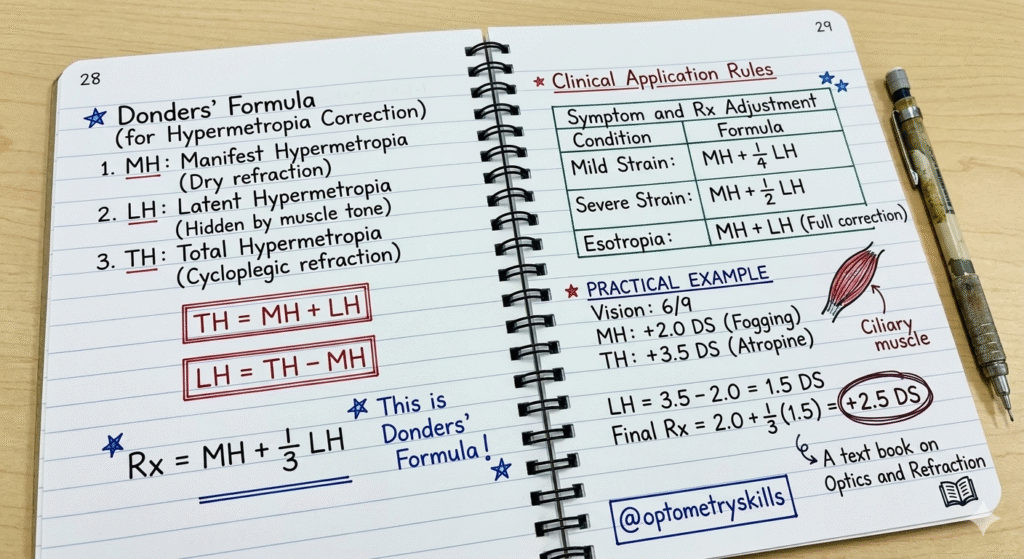
The Definitive Guide to Donders’ Formula in Optometry
Donders’ Formula is a cornerstone of clinical refraction, specifically used to manage Hypermetropia (farsightedness). While modern auto-refractors provide quick data, Donders’ Formula remains the gold standard for clinicians aiming to balance visual acuity with patient comfort, particularly when treating accommodative asthenopia.
1. The Physiology of Hypermetropia
To understand the formula, we must first categorize how the human eye manages hypermetropic errors. Unlike myopia, the eye can partially “self-correct” hypermetropia through the ciliary muscle.
- Total Hypermetropia (TH): The full refractive error revealed only under cycloplegia (paralysis of the ciliary muscle).
- Latent Hypermetropia (LH): The portion of the error (usually ~1.0D) hidden by the natural physiological tone of the ciliary muscle.
- Manifest Hypermetropia (MH): The amount of error detected during a standard dry refraction. This is divided into:
- Facultative (FH): Error corrected by active accommodative effort.
- Absolute (AH): Error that cannot be compensated for, resulting in blurred distance vision.
2. What is Donders’ Formula?
Donders’ Formula provides a systematic way to calculate the final spectacle prescription ($Rx$) by incorporating a fraction of the Latent Hypermetropia into the Manifest value.
The Standard Equation:
Why use a fraction of LH?
If you prescribe only the Manifest value, the patient may continue to experience eye strain (asthenopia) because the ciliary muscle is still working too hard. If you prescribe the Total value, the patient will likely complain of “misty” or blurred vision because the ciliary muscle cannot instantly relax its natural physiological tone. Donders’ Formula acts as a bridge for neural adaptation.
3. Clinical Variations and Indications
Refraction is as much an art as a science. Depending on the patient’s symptoms (headaches, crossing of eyes, or blurring), the formula is adjusted:
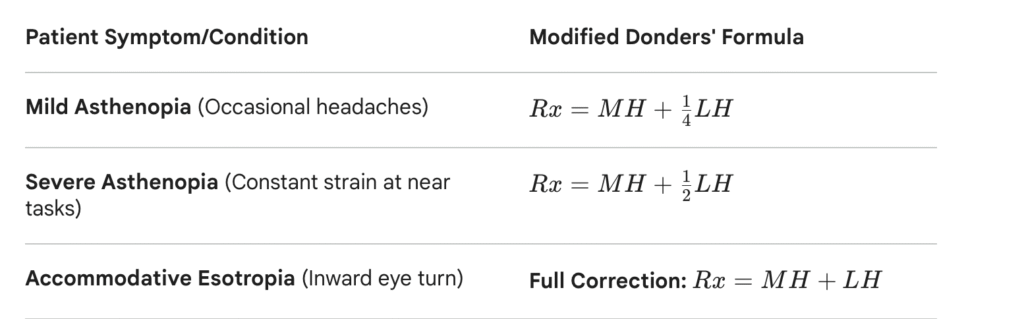
4. Step-by-Step Diagnostic Example
Let’s look at a clinical case study to see how this applies in a real-world exam.
5. Complications of Uncorrected Hypermetropia
Failure to apply the correct formula can lead to several clinical complications:
- Esophoria/Esotropia: Over-accommodation triggers the “accommodation-convergence” reflex, causing the eyes to turn inward.
- Narrow-Angle Glaucoma: Hypermetropic eyes often have shallower anterior chambers; uncorrected strain can exacerbate this predisposition.
- Chronic Blepharitis: Constant rubbing of strained eyes can lead to inflammation of the eyelid margins.
6. Summary for Practitioners
When treating hypermetropia, the goal is the maximum plus power for maximum visual acuity. Donders’ Formula ensures that the patient is not “over-plussed” to the point of distance blur, nor “under-plussed” to the point of continued headaches. It remains a vital tool in the “Scientific Correction of Hypermetropia.

Optometry education for Optometry students and eye care professionals. Managed by qualified optometrists. For informational purposes only — not a substitute for professional eye care.