
Macular Degeneration Eye Chart Test
There are moments in life when vision changes so subtly that we barely notice—until reading becomes difficult, faces blur, or straight lines appear distorted. Macular degeneration often begins this way, quietly affecting the central vision that we rely on every single day. The macular degeneration eye chart test, commonly known as the Amsler Grid test, is a simple yet powerful method that can help detect these early changes before they progress.
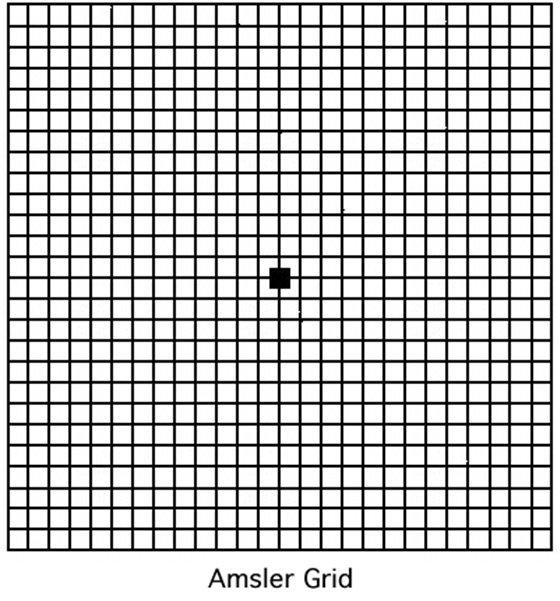
The macular degeneration eye chart test uses an Amsler Grid, a square chart made of straight horizontal and vertical lines with a central dot.
- Each small square represents a specific visual angle
- The chart tests the central 20° of your visual field
- It helps detect:
- Distortion (metamorphopsia)
- Blind spots (scotomas)
- Blurred areas
This test is widely used by eye care professionals and is also recommended for home monitoring, especially in patients at risk of macular degeneration.
We have online Amsler grid test through which you can mark the distortion and print a pdf to share with your doctor.
Why This Test is Important
Macular degeneration primarily affects the macula, the central part of the retina responsible for sharp, detailed vision.
Early signs you may notice:
- Straight lines appearing wavy or bent
- Words becoming difficult to read
- A dark or empty spot in the center of vision
- Colors appearing less vivid
The Amsler Grid test helps identify these symptoms early—sometimes even before you consciously notice vision loss.
Follow these steps carefully for accurate results:
Step-by-Step Instructions for Amsler grid test
- Wear your reading glasses if you normally use them
- Hold the chart at about 30–35 cm (normal reading distance)
- Ensure the chart is well illuminated
- Cover one eye
- Look directly at the central dot
- While focusing on the dot, observe:
- Do any lines look wavy, distorted, or bent?
- Are any areas blurred, dark, or missing?
- Repeat with the other eye
What Do the Results Mean?
Understanding your observations is key:
Normal Vision
- All lines appear straight
- All squares look uniform
- No missing or blurred areas
Possible Macular Degeneration
- Lines appear wavy or distorted
- Central area may look blurred or warped
Other Possible Issues
- Missing or faded areas without distortion may indicate:
- Optic nerve problems
- Other retinal conditions
Important:
If you notice any abnormalities, consult an eye care professional immediately. Early detection can significantly slow progression.
Types of Amsler Grid Charts


6
Different versions of the chart provide deeper evaluation:
- Standard Grid: Basic screening
- Diagonal Grid: Helps patients with central vision loss fixate better
- Red Grid: Detects color vision changes and subtle macular issues
- Dot Grid: Differentiates distortion from blind spots
- Line Grid: Useful for patients with reading difficulty
Who Should Use This Test Regularly?
The macular degeneration eye chart test is especially important for:
- People over 50 years of age
- Those with a family history of macular degeneration
- Patients with:
- Diabetes
- High blood pressure
- Previous retinal conditions
Regular use helps track changes and detect problems early.
How Often Should You Do It?
- High-risk individuals: Daily or several times a week
- General monitoring: Once a week
Consistency is key. Even small changes can be significant.
Tips for Accurate Testing
- Always test one eye at a time
- Do not perform the test immediately after bright light exposure
- Maintain proper distance and lighting
- Use the same chart regularly for comparison
When to Seek Medical Help
Contact an eye specialist immediately if you notice:
- Sudden distortion of lines
- New dark or blank spots
- Rapid change in vision
- Difficulty recognizing faces or reading
These may indicate progressive macular degeneration or choroidal neovascularization (CNV), which require urgent attention.
Final Reflection
The macular degeneration eye chart test is a reminder that sometimes the simplest tools carry the greatest impact. A few moments of attention each day can protect something priceless—your ability to see clearly, read comfortably, and recognize the faces you love.
Make this test a habit. Share it with your family. And most importantly, never ignore what your eyes are trying to tell you.

Optometry education for Optometry students and eye care professionals. Managed by qualified optometrists. For informational purposes only — not a substitute for professional eye care.