
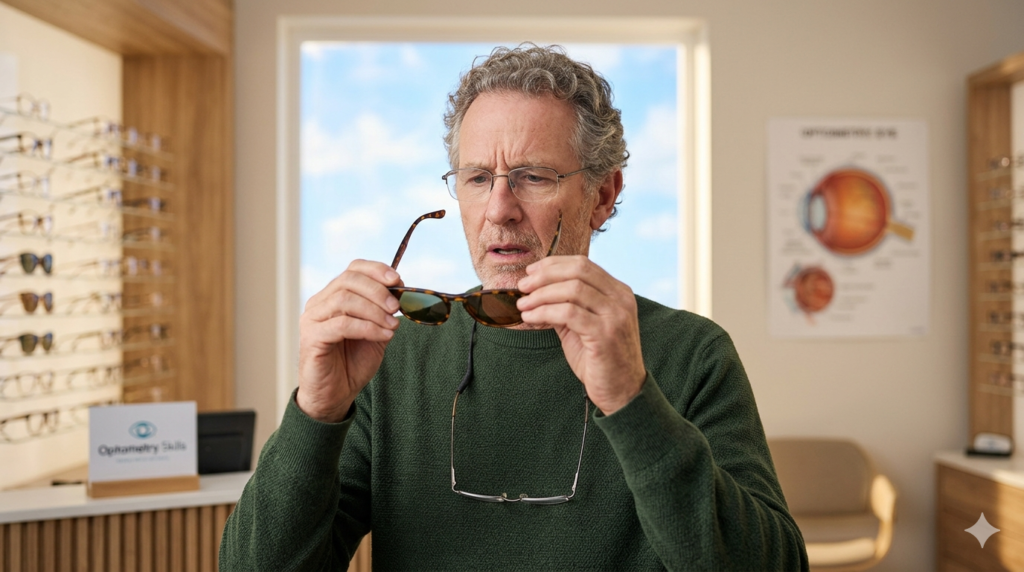
Can You See Phone Screens With Polarized Sunglasses?
We Eye care Professional hear a lot from the patients that their expensive new polarized sunglasses are “broken” because they make their smartphone or car dashboard disappear. In reality, what they are witnessing is a perfect, real-world demonstration of optical interference.
While polarized lenses are the gold standard for reducing glare on the road or water, they possess a unique relationship with digital displays. Understanding why this happens—and how display technology is evolving to fix it—is essential for any modern eyewear consumer.
1. The Physics of the “Crossed Polarizer”
To understand why your screen goes black, we must look at how both your sunglasses and your phone manage light.
Most digital screens (specifically LCDs) create images by filtering light through a polarizing film. This film ensures that all light leaving the screen is vibrating in one specific direction—usually diagonally or vertically.
Polarized sunglasses are manufactured with a vertical chemical filter designed to block horizontal light (glare). When you hold your phone in “Portrait” mode, the screen’s light waves usually align with the “slats” in your sunglasses, and you see a clear image. However, when you rotate the phone to “Landscape” mode, you rotate that light 90 degrees. Now, the light waves are horizontal, and your sunglasses’ vertical filter blocks them entirely.
Clinical Insight: This is known as Malus’s Law. When two polarizing filters are placed at a 90-degree angle to one another, the light transmission theoretically drops to zero.
2. LCD vs. OLED: Why Device Choice Matters
Not all screens are created equal when it comes to outdoor visibility. As display technology has advanced, manufacturers have found ways to mitigate the polarization clash.
The LCD Struggle (Liquid Crystal Displays)
LCDs, found in older iPhones, mid-range Androids, and almost all car dashboards, rely on backlighting passed through liquid crystals and polarizers. Because polarization is a fundamental part of how the image is created, these screens are the most likely to “black out” when viewed through polarized lenses.
The OLED Advantage (Organic Light Emitting Diodes)
OLED screens, found in flagship devices like the iPhone 15/16 Pro or Samsung Galaxy S24, work differently. Each pixel is its own light source. While many OLEDs still use a circular polarizer to reduce ambient reflections, they do not rely on the same linear polarization as LCDs.
- The Result: OLED screens remain visible at almost every angle, even with high-quality polarized sunglasses.
3. The “Rainbow Effect” (Birefringence)
Sometimes, your screen doesn’t go black, but instead looks like it’s covered in an oil slick or a rainbow. This is a phenomenon called birefringence or “double refraction.”
This happens when light passes through a material that has internal stress, such as a tempered glass screen protector or a plastic cockpit window. The material splits the light into two rays, which then interfere with each other, creating a colorful pattern when viewed through a polarizing filter. If you see “rainbows” on your phone, it is likely your screen protector or the tempered glass itself causing the interference, not the software.
4. Practical Workarounds for the Field
If you find yourself struggling to read your device while wearing your shades, use these three professional “hacks”:
- The 45-Degree Tilt: If your screen is black in landscape and bright in portrait, try holding it at a 45-degree angle. This allows some light from both axes to pass through the filter, making the screen legible.
- Circular Polarizer Check: Some premium sunglasses use “circularly polarized” lenses rather than “linearly polarized.” These are specifically designed to be more compatible with digital screens, though they are less common in standard retail.
- Brightness Override: While it won’t fix a total blackout, increasing your screen brightness can help overcome the “dimming” effect that occurs when the polarization axes are slightly misaligned.
5. When Visibility is a Safety Issue
In the clinic, I often advise certain professionals to avoid polarized lenses entirely.
- Pilots: Many cockpit instruments are LCD-based. A pilot tilting their head during a maneuver could cause their entire instrument panel to go dark.
- Medical Professionals: Some older diagnostic monitors in hospitals are polarized.
- Drivers with HUDs: Many “Heads-Up Displays” project light onto the windshield at a specific polarized angle. Wearing polarized sunglasses can make your speedometer or navigation prompts invisible.
6. Summary Checklist: Will My Phone Work?
| Display Type | Impact of Polarized Lenses | Best Orientation |
|---|---|---|
| Standard LCD | High (Likely to black out) | Portrait |
| IPS-LCD | Moderate (Dimming/Rainbows) | Variable |
| OLED / AMOLED | Low (Minimal impact) | Any |
| Dashboard/GPS | High (Can be dangerous) | Fixed (Tilt head to fix) |
Sources & Scientific Data
- Journal of Information Display: Optimization of Polarizer Orientation for Sunlight Readability (2025).
- Optical Society of America: The Effect of Polarized Sunglasses on Visual Performance with Electronic Displays.
- Optometry & Vision Science: Clinical implications of Birefringence in ophthalmic lenses.
- Tech-Ocular Research Group: Comparative study of OLED vs LCD visibility in high-ambient light.
Optometry education for Optometry students and eye care professionals. Managed by qualified optometrists. For informational purposes only — not a substitute for professional eye care.