
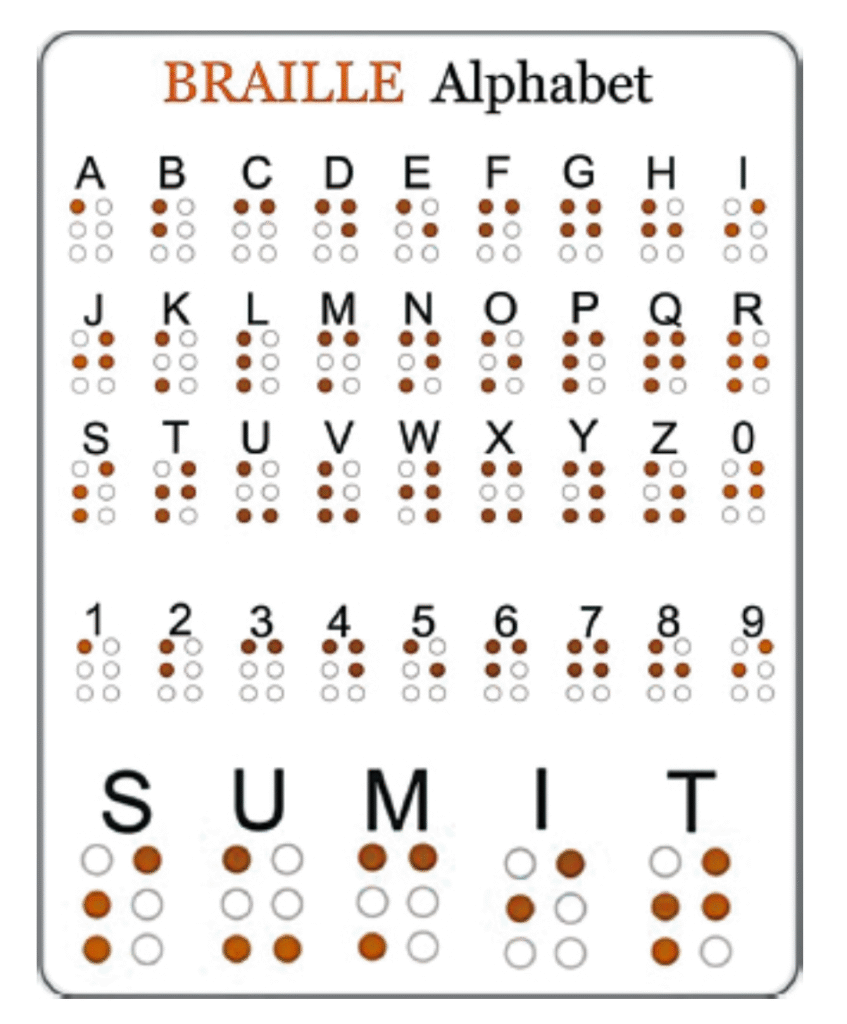
What are the Braille Alphabet?
The Braille alphabet is a tactile writing system that allows people with visual impairment to read and write through touch instead of sight.
It was invented in 1824 by Louis Braille, a French educator who lost his vision in childhood. His system transformed education, independence, and communication for blind individuals worldwide.
How Braille Works
Braille characters are formed using a cell of six raised dots arranged in two vertical columns of three dots each.
Dots are numbered:
Different combinations of raised dots represent different letters.
Basic Pattern Rule
The alphabet follows a logical pattern:
First 10 letters (A–J): use top four dots
Next 10 (K–T): same patterns + dot 3
Last letters (U–Z): same patterns + dots 3 and 6 (with W exception)
Numbers in Braille
Numbers use the same symbols as letters A–J, but are preceded by a number sign (⠼).
| Number | Braille Letter Used |
|---|---|
| 1 | A |
| 2 | B |
| 3 | C |
| 4 | D |
| 5 | E |
| 6 | F |
| 7 | G |
| 8 | H |
| 9 | I |
| 0 | J |
Example:
⠼⠁ = 1
⠼⠉ = 3
Punctuation Examples
| Symbol | Braille |
|---|---|
| Period | ⠲ |
| Comma | ⠂ |
| Question mark | ⠦ |
| Capital sign | ⠠ |
Capital letters are written by placing a capital indicator before the letter.
Grades of Braille
Grade 1 (Uncontracted)
Each letter written separately — used for beginners and children.
Grade 2 (Contracted Braille)
Common words shortened into symbols to increase reading speed.
Example: “the”, “and”, “for” have single-cell signs.
Grade 3
Personal shorthand, rarely standardized.
How People Read Braille
Readers gently move their fingertips from left to right across raised dots.
Experienced readers can reach reading speeds similar to print readers because the brain interprets patterns, not individual dots.
Importance of Braille Today
Even with screen readers and audio technology, Braille remains essential because it:
- Teaches spelling and grammar
- Enables silent reading
- Allows studying mathematics and science
- Promotes independence
Children who learn Braille early develop significantly stronger literacy skills compared to audio-only learners.
Quick Memory Tip
6 dots → patterns → letters → words → literacy
References
World Blind Union – Braille Literacy Resources
https://worldblindunion.org
UNESCO: Braille and Inclusive Education
https://www.unesco.org
American Foundation for the Blind – Learning Braille
https://www.afb.org

Optometry education for Optometry students and eye care professionals. Managed by qualified optometrists. For informational purposes only — not a substitute for professional eye care.