
Refraction Tips for sudden large degree Cylindrical Power
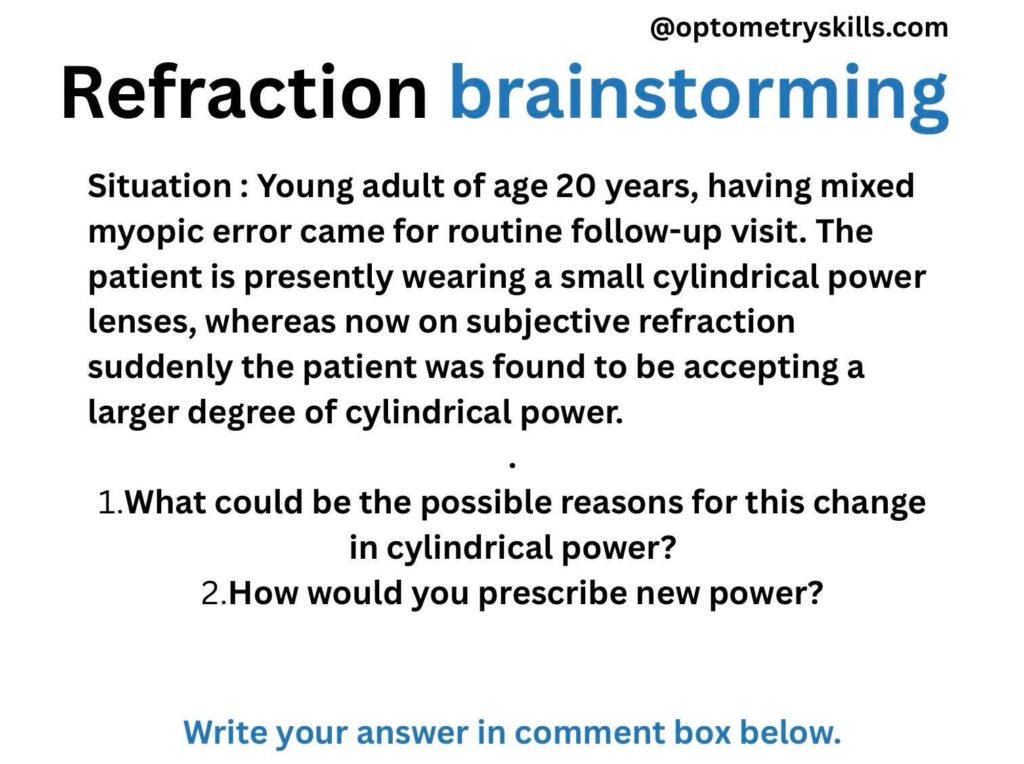
Scenario: A 20-year-old young adult with mixed myopic astigmatism presented for a routine follow-up visit. The patient was previously wearing spectacles with a small cylindrical correction. However, during subjective refraction at the current visit, the patient suddenly began accepting a significantly larger cylindrical power.
Questions
What could be the possible reasons for this sudden change in cylindrical power? How would you prescribe the new power?
Solution
Several factors may explain this finding:
(a) Actual Increase in Astigmatic Power
One possibility is a true increase in the patient’s astigmatism. However, it is uncommon for only the cylindrical component to increase suddenly without changes in the spherical component.
Therefore, before accepting this as genuine progression, it is essential to:
Recheck the previous prescription Verify earlier refraction records Rule out any measurement or prescribing errors
Corneal topography or keratometry may also be considered if irregular astigmatism is suspected.
(b) Over-Minusing of Spherical Power
A more common and clinically significant reason is over-minusing of the spherical component.
When excessive minus spherical power is given, the patient may appear to accept more plus cylinder during subjective refraction in order to maintain the same spherical equivalent.
Understanding the Spherical Equivalent Relationship
For every 0.50 D of excess minus sphere, approximately +1.00 D additional plus cylinder may be required to maintain the same spherical equivalent.
Let us understand this with an example:
Example 1
Suppose the exact refractive error is:
–2.00 DS / +1.00 DC × 90°
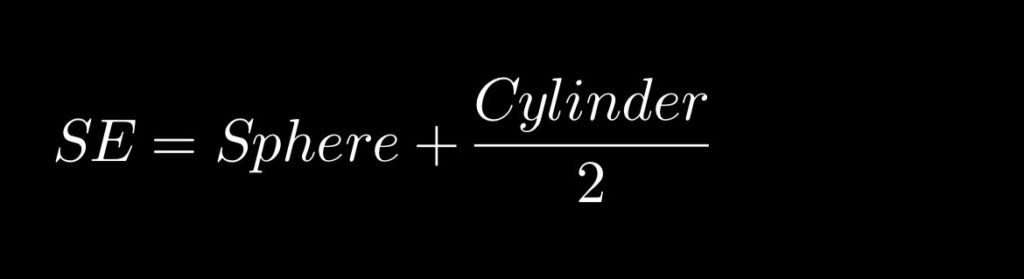
Spherical equivalent = –2.00 + (+1.00 / 2)
= –2.00 + 0.50
= –1.50 D
Now, if the patient is over-minused by –0.50 D sphere:
New spherical power = –2.50 DS
To maintain the same spherical equivalent (–1.50 D), the cylinder must increase.
Thus, the prescription may appear as:
–2.50 DS / +2.00 DC × 90°
Example 2
If the patient is over-minused by –0.75 D sphere:
New spherical power = –2.75 DS
To maintain spherical equivalent (–1.50 D), an additional +1.50 D cylinder would be required.
Resulting prescription:
–2.75 DS / +2.50 DC × 90°
This demonstrates how over-minusing sphere can falsely increase cylindrical acceptance.
2. How to Prescribe the New Power
Before prescribing the increased cylindrical correction, the following steps must be taken:
(a) Perform Cycloplegic Refraction
Cycloplegic refraction is essential to determine the true spherical and cylindrical error, especially in young patients where accommodation can influence results.
This helps eliminate accommodative spasm or latent hyperopia that may cause over-minusing during subjective refraction.
(b) Conduct Post-Mydriatic Test (PMT)
After cycloplegia wears off, a post-mydriatic test should be performed to determine:
The minimum minus spherical power accepted The maximum plus cylindrical power accepted
This ensures accurate balance between sphere and cylinder.
Final Prescription
The spectacle prescription should be based on:
Cycloplegic findings PMT refinement Best corrected visual acuity Patient comfort and binocular balance
Only after confirming that the increased cylinder is genuine and not due to over-minusing should the new cylindrical power be prescribed.
Clinical Takeaway
In young adults, sudden acceptance of higher cylindrical power is often due to excessive minus sphere rather than a true increase in astigmatism. Always verify with cycloplegic refraction before prescribing higher cylinder values.