
The New Gold Standard: A Deep Dive into the ZEISS Humphrey Field Analyzer 3 (HFA3)
For over three decades, the Humphrey Field Analyzer (HFA) has served as the bedrock of glaucoma management and neuro-ophthalmic diagnosis. As we progress into 2026, the Humphrey Field Analyzer 3 (HFA3) has solidified its position as the premier diagnostic platform, integrating advanced liquid optics, ultra-fast algorithms, and seamless data ecosystems.
This article explores the transformative features of the HFA3, the clinical implications of the latest research, and how it is redefining the efficiency of modern ophthalmic practices.
1. The Architecture of Speed: SITA™ Faster
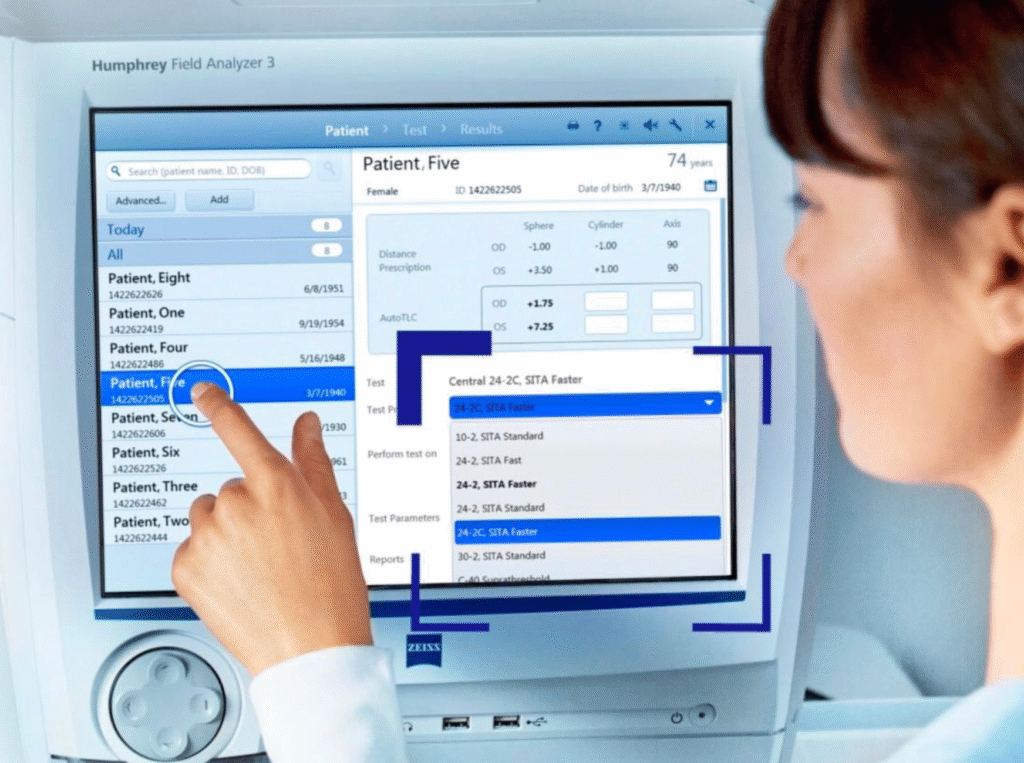
The most significant leap in perimetric efficiency is the introduction of the SITA™ Faster strategy. While the original SITA Standard revolutionized testing in the late 1990s, the HFA3’s SITA Faster 24-2 and 24-2C protocols have pushed the boundaries of patient endurance and clinical throughput.
Efficiency Without Compromise
According to recent clinical studies published in 2024 and 2025, SITA Faster reduces test time by approximately 50% compared to SITA Standard and roughly 30% compared to SITA Fast. For a typical patient, a 24-2 threshold test can now be completed in under three minutes per eye.
24-2C: Exploring the Central Field
One of the most clinically relevant updates in the HFA3 is the 24-2C test pattern. Standard 24-2 testing uses a 6-degree grid, which can sometimes overlook small, central scotomas that are critical in early-stage glaucoma. The 24-2C adds 10 additional points specifically selected to cover the areas most susceptible to early glaucomatous damage, effectively combining the breadth of a 24-2 with the precision of a 10-2 test in a single, rapid session.
2. Liquid Trial Lens™ Technology: Eliminating Human Error
In traditional perimetry, the technician must manually select and place trial lenses into a holder based on the patient’s refractive error. This process is prone to “lens rim artifacts” and errors in spherical calculation.
The HFA3 (Model 860) introduces the Liquid Trial Lens™, a patented technology that uses fluid pressure to instantly deliver the patient’s refractive correction.
- Automatic Adjustment: By importing the patient’s refractive data, the HFA3 automatically adjusts the liquid lens between -8 to +8 diopters.
- Reduced Setup Time: This technology eliminates the need for a traditional trial lens set, significantly reducing the “chair time” required for setup.
- Artifact Prevention: Because the correction is integrated, it minimizes the risk of peripheral shadows caused by traditional lens frames.
3. RelEYE™: Real-Time Fixation Monitoring
A common challenge in visual field interpretation is determining if a “blind spot” is a true pathological defect or the result of poor patient fixation. The HFA3 addresses this with RelEYE™.
RelEYE captures an image of the patient’s eye at every stimulus presentation. During the review, the clinician can click on any point on the numerical plot to see a video/image of the eye at the exact moment that point was tested. This provides:
- Diagnostic Confidence: Distinguish between a genuine scotoma and a “saccade” (eye jump).
- Patient Education: Show patients exactly where they lost focus, helping to improve performance in subsequent tests.
4. Advanced Data Integration and GPA™
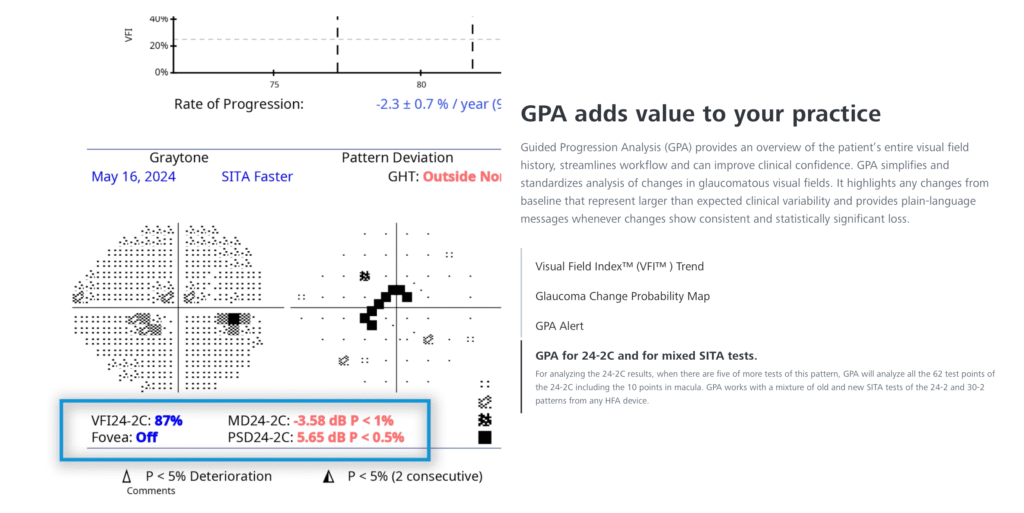
The HFA3 is not a siloed device; it is a node in a larger digital health ecosystem. Through the ZEISS FORUM® and the Glaucoma Workplace, the HFA3 offers a unified view of structural and functional change.
How to Choose the Best Aberrometer and 3 Top Aberrometers Preferred by Optometrists
Guided Progression Analysis (GPA)
The HFA3 utilizes the latest iterations of Guided Progression Analysis (GPA™). This software identifies statistically significant changes in the visual field over time, comparing current results to the patient’s own baseline.
- VFI (Visual Field Index): A global index that is less sensitive to cataract changes, providing a clearer picture of glaucomatous progression.
- Likelihood of Progression: GPA provides simple, color-coded alerts (e.g., “Possible Progression” or “Likely Progression”) to assist in rapid clinical decision-making.
Structure-Function Fusion
By combining HFA3 visual field data with CIRRUS™ HD-OCT scans, clinicians can now view “Structure-Function” maps. This overlay allows doctors to see if a thinning of the Retinal Nerve Fiber Layer (RNFL) on OCT correlates geographically with a visual field defect on the HFA3, significantly increasing diagnostic accuracy.
5. Technical Specifications & Model Comparison
The HFA3 series is designed to fit different practice needs, ranging from essential screening to advanced research-grade analysis.
| Feature | HFA3 Model 840 | HFA3 Model 850 | HFA3 Model 860 |
| SITA Faster | Yes | Yes | Yes |
| Gaze Tracking | Yes | Yes | Yes |
| RelEYE Monitoring | No | Yes | Yes |
| Liquid Trial Lens | No | No | Yes |
| Kinetic Perimetry | Optional | Yes | Yes |
| Vertex Monitoring | No | Yes | Yes |
6. Clinical Research and Future Outlook (2025-2026)
Recent longitudinal studies have focused on the “interchangeability” of data. A 2025 study confirmed that data from the older HFA II-i can be seamlessly migrated to the HFA3 without losing the GPA baseline. This is crucial for clinics managing patients over decades.
Furthermore, research into Virtual Reality (VR) Perimetry has highlighted the HFA3’s continued dominance. While VR headsets offer portability, the HFA3 remains the gold standard due to its standardized background luminance (31.5 apostilbs) and its massive normative database, which VR platforms currently lack the statistical depth to match.
Impact on Clinical Workflow
The combination of SITA Faster and Liquid Trial Lens technology has been shown to increase clinic capacity by up to 20%. In an era where the aging population is increasing the prevalence of glaucoma, these efficiency gains are not just “nice to have”—they are essential for maintaining a high standard of care.
7. Conclusion
The Humphrey Field Analyzer 3 represents the pinnacle of automated perimetry. By marrying the time-tested reliability of the Humphrey brand with cutting-edge innovations like SITA Faster and Liquid Lens technology, ZEISS has created a tool that respects the clinician’s time and the patient’s comfort. As we move deeper into 2026, the HFA3 remains the indispensable “gold standard” for anyone serious about the detection and management of glaucoma.
Resources & Further Reading
- ZEISS Medical Technology: HFA3 Official Product Page
- American Academy of Ophthalmology (AAO): Visual Field Testing Guidelines
- Journal of Glaucoma: Clinical Comparison of SITA Faster and SITA Standard Protocols
- ResearchGate: Impact of Liquid Trial Lens on Perimetric Outcomes
- Glaucoma Research Foundation: Understanding Your Visual Field Test

Optometry education for Optometry students and eye care professionals. Managed by qualified optometrists. For informational purposes only — not a substitute for professional eye care.