
Telemicroscope for Low Vision: Benefits, Working Distance & Uses
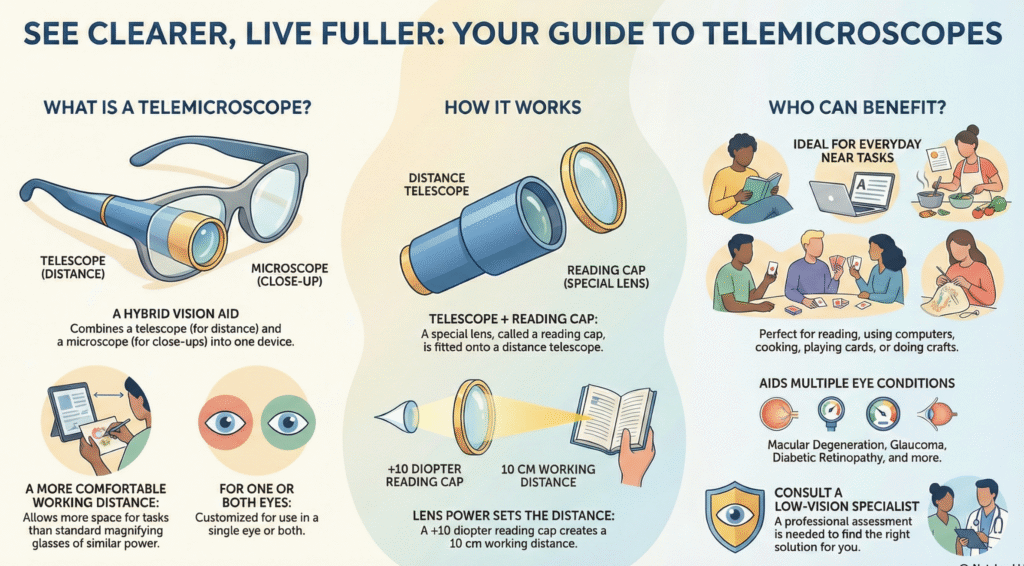
Telemicroscopes, frequently referred to as reading telescopes, are specialized optical devices adapted for close-range tasks through the use of an afocal lens system. These tools utilize a detachable reading cap positioned at the front of the unit, which users can easily install or remove depending on their visual needs. The specific focal distance for near work is dictated by the dioptric power of the attached cap, allowing for precise adjustments to the viewing range. For instance, higher power lenses significantly shorten the working distance required for the patient to see clearly. This flexible design allows individuals to transition seamlessly between standard distance magnification and detailed near-sight activities. Overall, the system provides a portable and customizable solution for those requiring enhanced visual assistance for reading or manual work.
Telemicroscope for Low Vision: How It Works & Why It Helps
Telemicroscopes are an important low vision aid that combine the benefits of telescope glasses for distance vision and microscope glasses for near vision. This unique device is especially helpful for people with macular degeneration, glaucoma, or diabetic retinopathy, who need better visual clarity for both distance and near tasks.
How Telemicroscopes Work for Distance Vision
In their basic form, telemicroscopes work like telescope glasses. They help the user see distant objects such as road signs, television screens, or faces across the room. The device uses an afocal telescope base, which provides magnification for distance vision and helps people with low vision maximize their usable sight.
How Telemicroscopes Work for Near Vision
To use telemicroscopes for near tasks, a reading cap or approach lens is added to the front of the telescope. This turns the device into a reading telescope, allowing clear vision for tasks like reading, writing, or using a phone.
- Customizable working distance:
The working distance depends on the power of the reading cap. For example, a +2.5 D reading cap gives a 40 cm working distance, while a +10 D cap gives a 10 cm working distance. - Increased magnification:
The total magnification for near tasks is a combination of the telescope and the reading cap. For example, adding a 12 diopter lens to a 2x telescope results in 6x magnification (24 diopters total). - Removable reading caps:
Reading caps can be removed and carried separately, making it easy to switch between distance vision and near vision.
Benefits of Telemicroscopes for Daily Activities
Telemicroscopes are more comfortable than traditional high-power magnifying glasses or handheld magnifiers. They provide a more natural working distance and are ideal for a variety of tasks, including:
- Reading newspapers and books
- Using a computer
- Cooking and food preparation
- Crafts and handwork
- Playing cards
- Using a smartphone
Telemicroscopes are usually mounted in glasses and can be customized for one eye or both eyes based on the patient’s needs.
Telemicroscope vs Hand Magnifier: What Are the Advantages?
The main advantage of telemicroscopes over standard hand magnifiers is that they allow a comfortable working distance. Hand magnifiers often require the user to hold the device close to the eyes, which can be tiring and unstable. Telemicroscopes, on the other hand, are mounted in glasses and allow hands-free use.
Key advantages include:
- Hands-free operation
Ideal for cooking, crafting, or using a computer. - Customizable working distance
A +2.5 D cap gives a 40 cm working distance, making near tasks easier and more stable. - Ideal for intermediate tasks
Perfect for computer use and other activities that need more distance than regular magnifiers. - Versatile use
Remove the reading cap to switch from near tasks to distance tasks, like watching TV or reading road signs. - Customized by low vision specialists
Each telemicroscope can be tailored to the patient’s visual needs, lifestyle, and diagnosis.
These devices are especially effective for people with age-related macular degeneration, glaucoma, and diabetic retinopathy.
How a Low Vision Consultation Personalizes Telemicroscopes
A low vision consultation ensures that the telemicroscope is customized to the patient’s specific needs. The process includes:
1. Assessing Goals and Lifestyle
The doctor evaluates the patient’s daily needs, such as reading, using a computer, cooking, or hobbies. This helps determine the ideal working distance and magnification.
2. Measuring Visual Loss
Using advanced tests, the optometrist measures the degree of vision loss caused by conditions like macular degeneration, glaucoma, or diabetic retinopathy.
3. Customizing the Device
The optometrist selects the right components:
- Choosing the telescope base (e.g., a 2x telescope)
- Selecting the reading cap power (e.g., +2.5 D for 40 cm, +10 D for 10 cm)
- Calculating total magnification
- Determining if one eye or both eyes need the device
4. Training and Instruction
Patients are taught how to switch between distance and near tasks and how to use the device correctly to maximize independence and visual performance.
FAQ
1. What is a telemicroscope?
A telemicroscope is a low vision aid that combines a telescope for distance vision and a microscope for near vision. It is mounted on glasses and helps people with low vision perform both distance and near tasks.
2. How does a telemicroscope work?
Telemicroscopes use an afocal telescope base for distance magnification. For near work, a removable reading cap or approach lens is added to the front, turning it into a reading telescope.
3. What is the working distance of a telemicroscope?
The working distance depends on the power of the reading cap. For example, a +2.5 D cap provides a 40 cm working distance, while a +10 D cap provides a 10 cm working distance.
4. How much magnification does a telemicroscope provide?
Total magnification is the product of the telescope’s power and the reading cap power. For example, adding a 12 D lens to a 2x telescope results in 6x magnification (24 diopters total).
5. What are the benefits of telemicroscopes over hand magnifiers?
Telemicroscopes offer hands-free use, customizable working distance, and better suitability for intermediate tasks like computer use. They also allow switching between distance and near vision by removing the reading cap.
6. Who can benefit from a telemicroscope?
Patients with low vision due to macular degeneration, glaucoma, diabetic retinopathy, or other visual impairments can benefit from telemicroscopes. They are especially useful for daily tasks like reading, using a computer, and crafts.
7. Can a telemicroscope be customized for each patient?
Yes, a low vision specialist can customize the telescope base, reading cap power, and eye configuration to match the patient’s visual needs and lifestyle.
8. Is a telemicroscope suitable for computer use?
Yes, telemicroscopes are ideal for intermediate tasks like computer use, as they provide a comfortable working distance and stable vision compared to handheld magnifiers.