
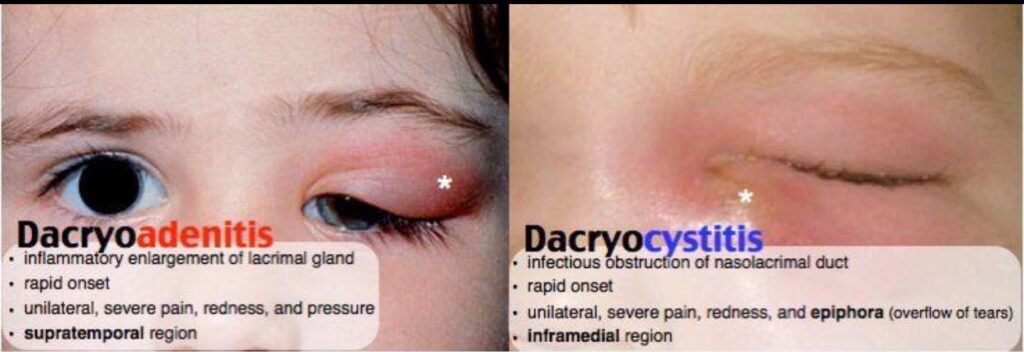
Dacryocystitis vs Dacryoadenitis: How to Differentiate Lacrimal Sac and Lacrimal Gland Infections
Painful swelling around the eye is a very common clinical presentation — yet students frequently confuse dacryocystitiswith dacryoadenitis.
Both involve the lacrimal system, both cause redness and tenderness, and both may present acutely.
However, they originate from entirely different parts of the tear apparatus and therefore behave very differently clinically.
The easiest way to understand them:
Dacryocystitis = Drainage problem
Dacryoadenitis = Production gland problem
Once you know where the swelling is located, diagnosis becomes almost obvious.
| Feature | Dacryocystitis | Dacryoadenitis |
|---|---|---|
| Structure involved | Lacrimal sac | Lacrimal gland |
| Function affected | Tear drainage | Tear production |
| Location | Medial canthus | Superolateral eyelid |
| Watering | Prominent | Mild/absent |
| Pus from punctum | Present | Absent |
| Ptosis | No | S-shaped ptosis |
| Cause | Nasolacrimal duct block | Infection (usually viral) |
| Surgery | DCR required | Rarely needed |
Dacryocystitis is an infection of the lacrimal sac caused by obstruction of the nasolacrimal duct.
Because tears cannot drain into the nose, they stagnate in the sac, allowing bacteria to grow and form pus.
Key Clinical Features
- Painful red swelling below medial canthus
- Excessive watering (epiphora)
- Pus regurgitation from punctum on pressure (ROPLAS positive)
- Pointing abscess in acute stage
- Chronic watering in long-standing cases
Causes
- Primary nasolacrimal duct obstruction (most common)
- Age-related narrowing
- Chronic inflammation
Treatment
- Warm compresses
- Oral antibiotics
- Incision & drainage if abscess forms
- Definitive treatment: Dacryocystorhinostomy (DCR)
What is Dacryoadenitis?
Dacryoadenitis is inflammation of the lacrimal gland, the structure responsible for producing tears.
It is usually caused by viral infection and often associated with systemic illness.
Key Clinical Features
- Painful swelling in outer upper eyelid
- S-shaped ptosis
- Tender enlarged lacrimal gland
- Fever or malaise
- Mild or absent watering
Causes
- Viral infections (mumps, EBV) – most common
- Bacterial infection (staphylococcus)
- Rare inflammatory disorders
Treatment
- Viral → supportive care
- Bacterial → systemic antibiotics
- Surgery rarely required