
Cornea of the Eye and disease of the Cornea
What Are the Most Common Corneal Disorders?
Vision begins at the surface of the eye. Before light reaches the retina, it must first pass through a crystal-clear structure that quietly does most of the focusing—the cornea. Though thin and transparent, the cornea is one of the most important parts of the visual system. Even mild damage to it can cause discomfort, blurred vision, or, in severe cases, permanent visual loss.
Understanding the cornea of the eye and its problems helps in recognizing early warning signs and seeking timely treatment. In this article, we will read about the cornea, its structure and function, and the most common corneal disorders seen in everyday eye practice.
What Is the Cornea of the Eye?
The cornea is the clear, dome-shaped outer covering at the front of the eye. It covers the iris (the colored part) and the pupil and serves as the eye’s primary refractive surface.
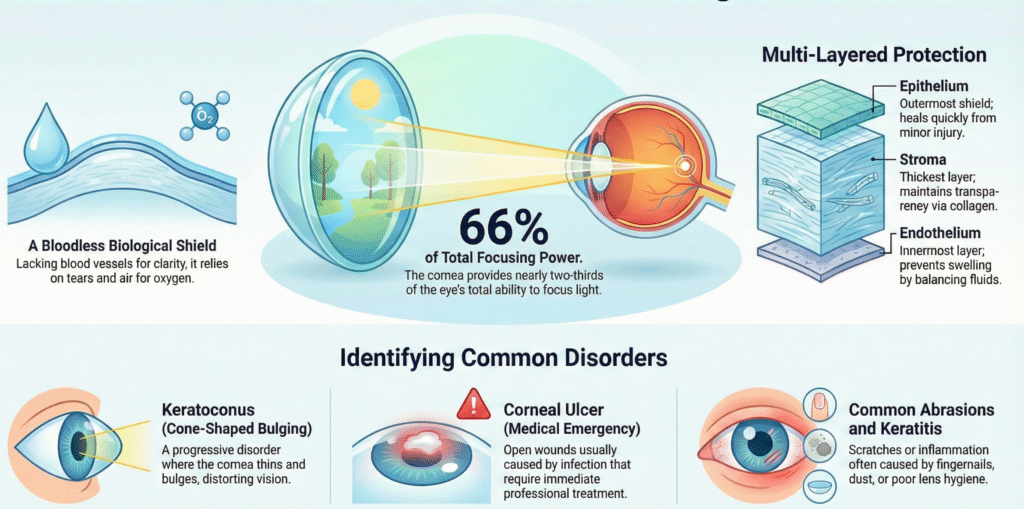
Unlike most tissues in the body, the cornea has no blood vessels, which keeps it transparent. It receives oxygen from the air and nutrients from tears and the aqueous humor inside the eye.
Because the cornea is exposed directly to the environment, it is particularly vulnerable to injury, infection, and dryness.
Functions of the Cornea
The cornea performs several critical functions essential for clear vision:
- Focusing light: The cornea provides nearly two-thirds of the eye’s total focusing power.
- Protection: It acts as a shield against dust, microorganisms, and harmful particles.
- Maintaining eye shape: It contributes to the structural integrity of the eye.
- Filtering UV rays: It helps reduce ultraviolet light entering the eye.
Any condition affecting the cornea can disturb these functions, leading to visual distortion or discomfort.
Layers of the Cornea Explained Simply
The cornea consists of five specialized layers, each playing a vital role:
1. Epithelium
The outermost layer that protects the eye from injury and infection. It heals quickly after minor damage.
2. Bowman’s Layer
A tough layer that provides strength and shape to the cornea.
3. Stroma
The thickest layer, made of collagen fibers arranged precisely to maintain transparency.
4. Descemet’s Membrane
A strong protective layer that supports the inner cornea.
5. Endothelium
The innermost layer that regulates fluid balance. Damage here can cause corneal swelling and blurred vision.
Problems in different layers lead to different corneal diseases.
What Are Corneal Disorders?
Corneal disorders are conditions that affect the clarity, shape, or health of the cornea. These disorders may be caused by:
- Infections
- Injuries or trauma
- Contact lens misuse
- Dry eye disease
- Genetic or degenerative conditions
Some corneal disorders are mild and temporary, while others are progressive and vision-threatening.
Most Common Corneal Disorders
1. Corneal Abrasion
A corneal abrasion is a scratch on the corneal surface, often caused by fingernails, dust, makeup brushes, or contact lenses.
Symptoms include:
- Sharp eye pain
- Redness and watering
- Sensitivity to light
- Foreign body sensation
With prompt treatment, most abrasions heal within a few days.
2. Keratitis (Corneal Inflammation)
Keratitis is inflammation of the cornea and may be infectious or non-infectious.
Common causes:
- Bacterial or viral infections
- Improper contact lens hygiene
- Eye injuries
- Severe dry eye
If untreated, keratitis can progress into a corneal ulcer.
3. Corneal Ulcer
A corneal ulcer is an open wound on the cornea, usually due to infection.
Warning signs include:
- Severe pain and redness
- Blurred or reduced vision
- White or gray spot on the cornea
- Eye discharge
Corneal ulcers are medical emergencies and require immediate treatment.
4. Keratoconus
Keratoconus is a progressive disorder where the cornea becomes thin and bulges forward into a cone shape.
Typical symptoms:
- Gradually worsening vision
- Frequent change in spectacles
- Light sensitivity
- Distorted or ghost images
Early diagnosis is crucial to slow progression and preserve vision.
5. Corneal Dystrophies
Corneal dystrophies are inherited conditions where abnormal deposits accumulate in the cornea.
Key features:
- Usually affect both eyes
- Progress slowly
- May cause glare, pain, or blurred vision
Fuchs’ endothelial dystrophy is one of the most common types.
6. Dry Eye–Related Corneal Damage
Chronic dry eye disease can damage the corneal surface due to insufficient or poor-quality tears.
Symptoms include:
- Burning or stinging sensation
- Grittiness
- Fluctuating vision
- Eye fatigue
Untreated dry eye can lead to corneal inflammation and epithelial defects.
7. Corneal Scarring
Scarring may occur after infections, injuries, or surgery. Depending on its size and location, it can significantly reduce vision by blocking light entry.
How Are Corneal Disorders Diagnosed?
Eye care professionals use specialized tools such as:
- Slit-lamp examination
- Fluorescein staining
- Corneal topography
- Pachymetry (corneal thickness measurement)
Early diagnosis improves treatment outcomes significantly.
Treatment Options for Corneal Problems
Treatment depends on the underlying condition and may include:
- Antibiotic, antiviral, or antifungal eye drops
- Lubricating and medicated eye drops
- Bandage contact lenses
- Corneal cross-linking
- Surgical procedures such as corneal transplantation
Most corneal disorders respond well when treated early.
How to Protect the Cornea Naturally
Simple daily habits help maintain corneal health:
- Avoid rubbing the eyes
- Maintain strict contact lens hygiene
- Wear protective eyewear when needed
- Treat eye infections promptly
- Schedule regular eye examinations
Conclusion
The cornea of the eye is essential for clear, comfortable vision. From minor abrasions to serious conditions like keratoconus and corneal ulcers, corneal disorders can affect people of all ages. Awareness, early recognition of symptoms, and timely treatment are key to preserving vision and preventing complications.
Taking care of the cornea is, in reality, taking care of sight itself.